

The Greatest Knight: The Remarkable Life of William Marshal, the Power Behind Five English Thrones, Thomas Asbridge (Ecco, 2015).
In 1152, King Stephen of England very nearly killed a five-year-old boy.
He would have been far from the first child to die on Stephen’s account, because at this point England was fourteen years into a civil war so brutal that the Peterborough Chronicle recorded that men “said openly that Christ slept” (þa sæden openlice ðæt Crist slep. ⁊ his halechen),1 but this time was different. This time, the king had to order the boy’s death himself.
The medieval English royal succession was never as neat as Crusader Kings mechanics would have you believe, but even so Stephen I (and only) was an unlikely king. His mother Adela was the youngest child of William the Conqueror. She had four older brothers, three of whom survived their father, and Stephen himself was the third of her sons. But the Conqueror’s eldest son, Robert Curthose, mortgaged his duchy of Normandy to fund his participation in the First Crusade and would go on to spend the decades after his return in comfortable captivity. His second son, Richard, was killed as a teenager in a hunting accident in the New Forest in 1070, and his third son, William Rufus, succeeded him as king, never married, and was also killed in a hunting accident in the New Forest (this time in 1100). If this seems suspiciously convenient, it was: the youngest brother, Henry, was also on the fatal hunting trip. He immediately rode hard for Winchester, where he was crowned three days later.
Henry I promptly married Matilda, whose father was the king of Scotland and whose mother Margaret (later canonized by Innocent IV) was the sister of Edgar Ætheling: Henry and Matilda’s son William, born in 1103, united the blood of the Norman conquerors and the old Anglo-Saxon House of Wessex. Their daughter, another Matilda, was sent off to Germany at the age of eight to marry the twenty four-year-old Holy Roman Emperor Henry V. And that was it: Henry I also fathered at least twenty-two attested bastards, but William and Matilda were his only legitimate children. Which meant that when a drunken helmsman wrecked the ship carrying William and at least three hundred other flowers of the Anglo-Norman nobility across the Channel, Henry was in deep trouble. Luckily for him, his daughter soon returned from Germany a childless widow and once he had remarried her to Geoffrey of Anjou he was able to browbeat his barons into accepting her as his heir. Unluckily for him, they didn’t mean it: Empress Matilda was deeply unpopular even beyond the fact that she was a woman, and as soon as Henry died they were happy to crown his nephew Stephen instead.
The ensuing civil war, known to history as “the Anarchy,” was exciting and dramatic and featured such moments as a king captured on the battlefield, a queen climbing out the window of a besieged castle and escaping through a snowstorm, and a teenage boy invading England with a mercenary army he couldn’t afford to pay. For our purposes, though, all you really need to know is that in 1152 Stephen laid siege to a castle in Berkshire that John Marshal, a supporter of Matilda, had built without royal authorization. (These are apparently called “adulterine castles,” which I think is delightful.) Marshal asked for a truce to consult with his constable and organize the garrison’s surrender and offered his youngest son William as a hostage for his good behavior. Stephen accepted, took the boy into his camp, and withdrew to let Marshal enter with his men.
And then John Marshal stayed in the newly-reinforced castle instead.
Using your children as diplomatic hostages was standard practice in this era. Abandoning them to be executed as punishment for your bad faith was definitely not. But when Stephen’s men told John Marshal that his son’s life would be forfeit for his treachery, Marshal is said to have replied that he didn’t care, because he still had “the anvils and the hammers to forge even finer ones.” Stephen was not, in the end, able to bring himself to kill young William: the story has it that he lost his nerve when the boy asked on his way to the gallows whether he could play with a guard’s spear “afterwards,” and then again when William happily climbed into the catapult they planned to use to send him over the walls to his father (he thought it was a swing). He did, however, remain a hostage in Stephen’s camp until the end of the war a year later.2
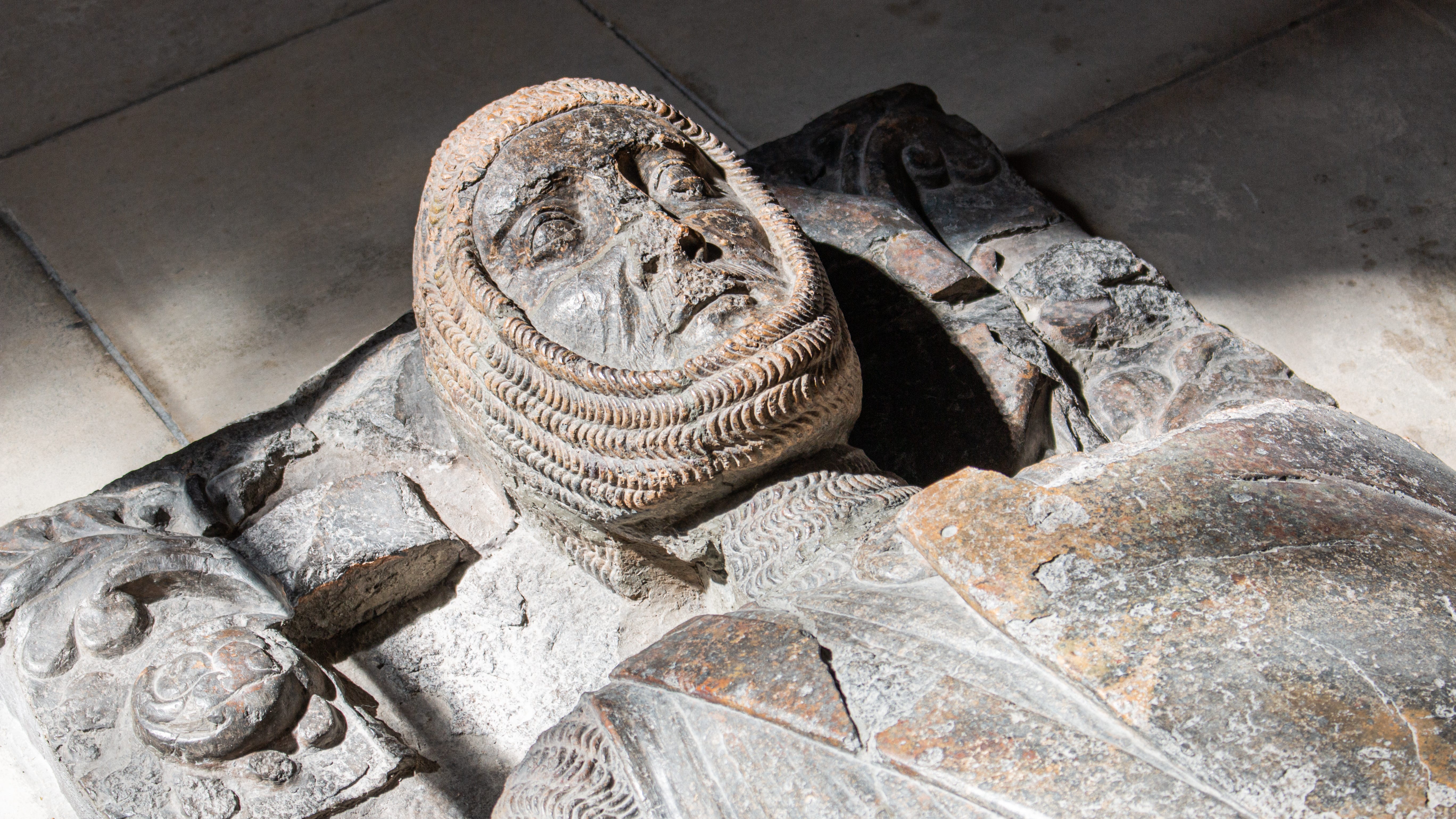
Our only source for this story of William’s childhood, and for most of the truly excellent stories medievalist Thomas Asbridge recounts in The Greatest Knight, is a 19,215 line rhyming poem in medieval French. Probably composed a few years after William Marshal’s death at the behest of his friends or children, and pretty well corroborated by other sources where other sources exist, the poem is our only surviving example of a medieval biography of a “normal” person. (Relatively speaking; that little boy grew up to be an incredibly accomplished man but neither a king nor a saint, which is who usually got written about.) Moreover, it seems to have been compiled from stories told by people who actually knew him — which probably means that he was the one who told them about the child who thought the catapult was a swing. The poem exists in only one manuscript,3 discovered by Paul Meyer in the late 19th century and published with partial translations into modern French as L’histoire de Guillaume le Maréchal. (You can find Meyer’s version here or here.) More recently, Nigel Bryant published a full English translation, the text of which isn’t available online, though I’ll point out that even Claude Sonnet does a pretty decent job with screencaps of the original.4
So why read Asbridge’s book rather than the original History of William Marshal, or one of the highly-regarded biographies?5 (Sidney Painter’s 1933 volume, Georges Duby’s 1985 one, and David Crouch’s, originally published in 1990 but with a third edition in 2016, are all helpfully titled William Marshal.) Well, partly take a look at the relative prices and library availability of the various options and consider that I do most of my reading on a Kindle at the playground. But less prosaically, Asbridge’s book is a delight because it uses Marshal’s story as a lens on a far broader medieval picture. Of course any history worth its salt has to give you enough6 background material to contextualize its main narrative, but plenty of authors stop at “what can my expert broader knowledge of the period add to your understanding of the story I’m trying to tell?” without going on, as I prefer, to “…and what can the story show us about the period?” (This is more a genre issue than anything else: academic works are usually meant for audiences already familiar with the broad picture and interested in zeroing in on the brushwork down in this corner, where Asbridge is writing for the educated layman. But since I am an educated layman, this pleases me.)
Not that Asbridge slacks on the “expert broader knowledge” front. Against arguments that John Marshal’s apathy about his son’s survival was a period-typical response to an era of high child mortality, he shares a story from Gerald of Wales to argue that no, medieval people really did expect parents to care about their kids:
[…the] ruthless castellan [of the castle of Châteauroux] took one of his enemies captive and, so as to ensure that he posed no further threat, had the poor wretch blinded and castrated. … Thus emasculated, the man remained a prisoner for many years, but was given the freedom to roam the fortress, crawling and stumbling as he went. In time, however, he ‘committed to memory all [its] passageways and even the steps which led up to the towers’, and through all these long days, forgotten and ignored by those around him, the man nursed his cold hatred. …when an opportunity presented itself, the mutilated captive took sudden and terrible action. Seizing the lord of Châteauroux’s only son and heir, the prisoner dragged the boy ‘to the topmost crenellation of one of the towers’, locking all the doors behind him, and there ‘he stood outlined against the sky, threatening to throw the boy over’. The castle erupted in chaos as ‘everyone screamed in anguish’. According to Gerald:
“The boy’s father came running, and no one’s distress was greater than his. He made every offer he could think of in an attempt to obtain his son’s release. [But] the prisoner replied that he would not give the boy up until the father had first cut off his own testicles, [and though] the castellan went on with his appeals, they were all in vain.”
…the lord of Châteauroux eventually resolved to feign agreement and beckoned an onlooker to deliver ‘a mighty blow [to his] lower body, to give the impression that he had mutilated himself’, while ‘all those present groaned’ at the sight. But the blind man was not so readily fooled. He called out, asking the castellan ‘where he felt the most pain’ and when the lord ‘replied falsely that it was in his loins’, the captive stepped forward, readying himself to push the boy over. The castellan had himself struck a second time and, in answer to the same question, claimed that ‘worst pain was in his heart’, but again he was not believed. By now, the blind man had dragged his hostage ‘to the very edge of the parapet’. Finally, the lord realised he could hesitate no longer:
“The third time, to save his son, the father really did cut off his own testicles. He shouted out that it was his teeth that hurt most. ‘This time I believe you,’ said the blind man, ‘and I know what I am talking about. Now I am avenged of the wrongs done to me, in part at least… You will never beget another son, and you shall certainly have no joy in this one.’”
With that, the blind man ‘hurled himself over the battlements…taking the boy with him’, and both died, their bodies broken by the dreadful fall.
Whether or not this actually happened — Asbridge thinks it sounds fantastical and I have no personal experience of castration to compare — Gerald of Wales clearly assumed his audience would understand a father’s willingness to suffer terribly in order to save his child. John Marshal’s parenting seems to have been the outlier in his era as well as ours.7
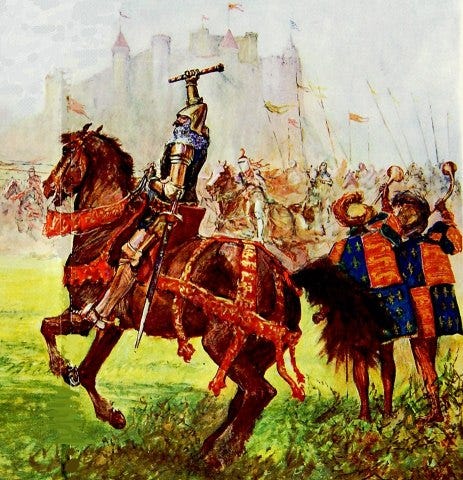
The end of the Anarchy was good news for William, who got to go home to his family (the History reports that “his mother was overjoyed to see him” without mentioning his father), but it also dramatically reduced opportunities for social mobility. As a younger son, William stood to inherit virtually nothing he couldn’t win for himself: in a war, he would have had the opportunity to ascend by feats of arms, but in peacetime his options were fewer. Either way, though, he would need training, so he was sent off to the household of his mother’s kinsman William of Tancarville in Normandy. (I’m really sorry about all the Williams.) The History doesn’t have much to say about this period, which probably lasted six or seven years, beyond noting — in another bit that has the ring of a story later told and retold by William Marshal himself — that “people thought it a great pity that he retired to bed so early and yet slept so late” and that he acquired the nickname gasteviande or “greedy guts.” (There’s hope for your teenage son yet.)
William’s time in Tancarville would obviously have been spent acquiring the martial skills necessary for a 12th century knight — horsemanship, swordplay, and lance-work, typically while wearing forty-plus pounds of iron — but just as important was developing the relationships he’d need in order to get someone to buy all this for him. A warhorse or destrier alone was ruinously expensive: price comparisons across history are a dangerous affair, but when William was a teenager in the 1160s, the average price of a destrier could also buy you forty riding horses, two hundred packhorses, five hundred oxen, or ~4,500 sheep.8 (To calibrate: in this era, a large herd of sheep was about two thousand.) Armor and weapons weren’t as expensive, and were less likely to be killed on the battlefield, but they didn’t come cheap either. A lord with tenants and income of his own could afford to maintain himself as a knight. A younger son, not entitled to inherit anything from his father, definitely couldn’t.
And here we come to the thing that our popular image of the knight — and therefore our nigh-infinite stock of cod-medieval fantasy literature9 — ignores: the practical reality of a political and military system built around large numbers of highly-trained, expensively-equipped mounted warriors. This doesn’t just mean feudalism (although yes, it means feudalism, go read the Wikipedia article about that if you like and also manorialism while you’re at it); it also means the economics of training and supplying these men and the social systems necessary to control their behavior. In particular, right here, it means the mesnie.
Mesnie derives from the Latin mansio, house (cf. “mansion”), so you could translate it as something like “household” or “retinue.” Neither of those would really be wrong, per se, but they sound so bureaucratic and administrative that they’re a little misleading to a modern reader. You’ll get a better picture of the mesnie in practice if you think of it as a rapper’s posse, a capo’s lieutenants, or (for you Beckwith-heads out there) the warlord’s comitatus. Asbridge describes the mesnie as a “tightknit group of warriors serving as elite troops and trusted bodyguards” to a lord. They gave him their loyalty and served him in the field, and “in return a noble was expected to shelter his warriors, protecting their status and advancing their careers.” Which of course included providing arms and armor, horses, and eventually perhaps lands, titles, and advantageous marriages. In short, when young William finished his training he needed a patron — but unfortunately, he’d lost the lord of Tancarville.
William had enjoyed his first skirmish as a knight in a small border war in eastern Normandy. Then the war ended (the Normans won), which meant Tancarville’s mesnie was facing layoffs. Even in the twelfth century the newest hires were the first to go. To make matters worse, William’s warhorse had been killed in the fight, and while the History says he did well in the fighting, he hadn’t captured any enemy knights and so had no one to ransom for the money to buy a new horse. Frankly, after the skirmish he was worse off than he had been when he started: he had his sword, his armor, and the cloak he’d been given when he was knighted. Then he sold the cloak for enough money to buy a packhorse to carry everything else — another reminder of how very differently things were priced in the past, can you imagine an article of everyday clothing today that costs the same as a horse? —and he went out to seek his fortune.
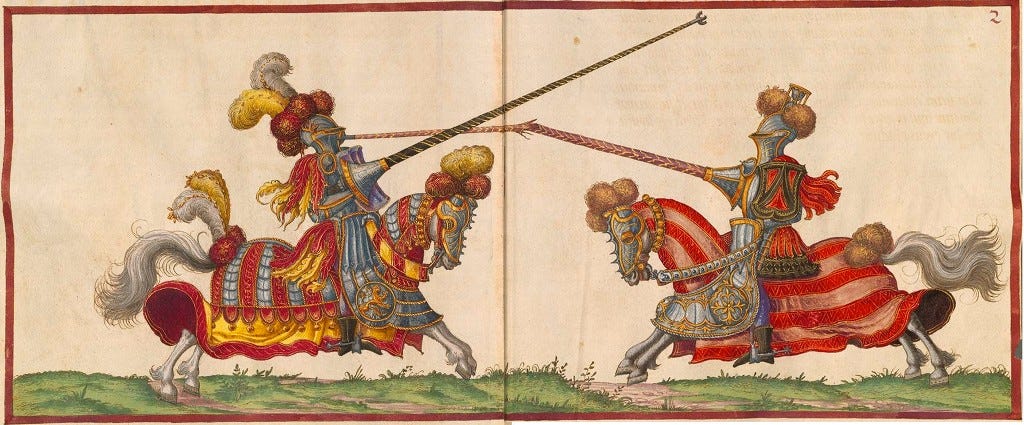
At this point we confront the second major “they don’t put this in the movies” element of William Marshal’s story, which is the tournament.
“But wait!” you may well cry: obviously they do put tournament scenes in the movies, from the technicolor to the grimdark to the plain old goofy. But all that gallant jousting and ladies’ favors comes later: the tournaments of his day, Asbridge writes, “were entirely different beasts: imbued with some pageantry and awash with colour, yes, but riotous, chaotic affairs, tantamount to large-scale war games, played out by teams of mounted knights across great swathes of territory.” Hundreds or even thousands of knights gathered in whatever town was hosting the games, organized into two coalitions of allied teams distinguished by color (typically English/Norman vs. French), then battled across many square miles of countryside over the course of the day. For a modern equivalent in terms of social class, danger, and expense, you might imagine a horde of Saudi princelings descending on a succession of cities to race Formula One cars through the streets. Tournaments weren’t intended to kill — the goal was to capture an opponent and ransom him back for the price of his armor and horse, which could be astronomical — but of course men did die. (In fact, one could argue that tournament lethality is responsible for the entire Anglo-American constitutional tradition: Geoffrey, Duke of Brittany, the brother between Richard the Lionheart and King John in the birth order, was accidentally trampled to death by his mesnie during a tournament in Paris a few years before their father’s death. And while counterfactuals are hard, my guess is that Geoffrey was politically competent enough that he wouldn’t have gotten stuck signing the Magna Carta. John was really very bad at being king.)
Anyway, the tournaments of the 12th century were professional sports just as much as were the later, more cinematic jousts, but because they were spread over so much territory they couldn’t support spectators outside of the participants. That didn’t really matter, though: there existed no outside social class to spectate. The knights who rode in tournaments were performing for each other. Their games were simultaneously entertainment to keep professional warriors out of trouble when there was no war on, individual and collective practice for future wars, and an opportunity to demonstrate the kind of martial prowess (on one side) and munificence (on the other) that formed the basis of lordly relationships. Performing well in a tournament could bring wealth and prestige on its own, but it could also earn a knight a place in a lord’s household. Visibly equipping your own knights well and feasting your fellows could attract more and better warriors to your banner, which let you win more tournaments and hopefully one day battles.
Asbridge argues that the knightly code of conduct called chevalerie (from cheval, horse, and therefore to be understood literally as “how a horseman acts” rather than any later romantic associations we may bring to the term) had the 12th century tournament as its “catalyst and cauldron.” The well-armed, mobile, mounted warrior was not a new military reality in Western Europe, but the advent of the Crusades — and more specifically, the creation of Christian knightly orders like the Templars and Hospitallers that fused monastic ideals onto a cultural figure that had hitherto been basically “a guy with a sword sitting on an animal that can trample you to death, please give him your stuff now” — kicked off a process of cultural accretion that quickly grew to include a literary tradition of chansons de geste (literally “songs of deeds”) focused on “daring bravery and wondrous martial prowess” as well as honor and loyalty. (Meanwhile in England, the legend of Arthur and his knights was invented in the 1130s.)10
Unlike a real battle, where honor and self-interest could come into dramatic conflict (with a castle or kingdom on the line, who wouldn’t be tempted to surrender and then, uh, strategically un-surrender when the enemy’s back was turned?), a tournament was thrilling and dangerous but still a game11 — and games are only fun if there are rules. The code of what it meant to be a guy on a horse, a chevalier, grew from the rules of a game whose audience was identical to its participants. As chevalerie went beyond what necessarily adheres to guys on horses, it came to govern the honorable behavior of knights to other knights: protecting your lord, keeping your word and staying captured once you’d been captured, engaging only armored opponents rather than sneaking into the tent where men went to rest and get a drink of water (yes, “base” in what was essentially the world’s most dangerous game of tag). A warrior class that constructed its social identity partly through these tournaments would keep those ideals on a real battlefield, too. Plenty of other societies had heavy cavalry (the Mongols did, and every empire from the Persians to the Byzantines had cataphracts): what made a knight a knight wasn’t the existence of the armored man on a horse but the specific culture that formed around him.
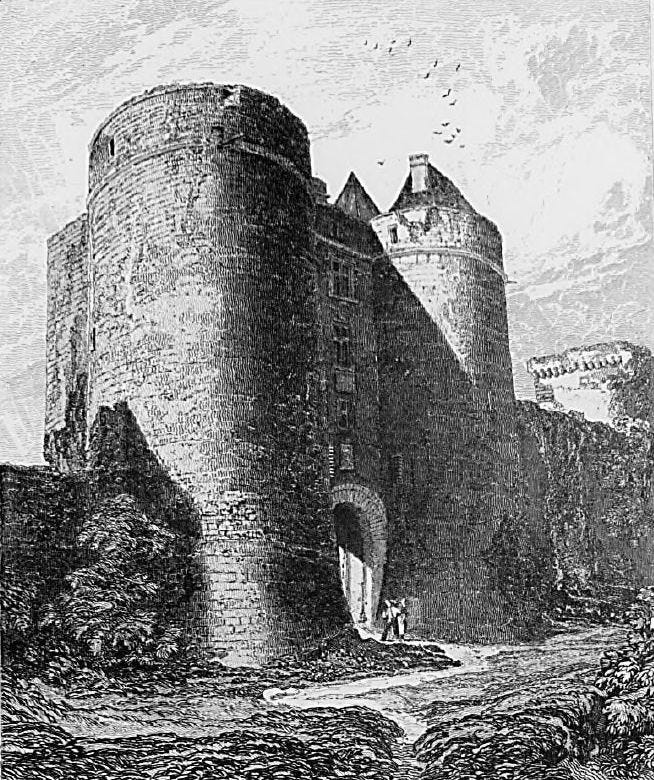
William entered his first tournament just after leaving Tancarville’s mesnie. At this point he was about twenty, and the History says that he was tall, “so well-fashioned that, even if he had been created by the sculptor’s chisel, his limbs would not have been so handsome,” with “fine hands and feet” and “a crotch so large…that no noble could be his peer.” (Alas, Asbridge spoils this by noting that this “almost certainly…referred to the width of his hips and natural predisposition for the horse saddle.”) He did remarkably well, “securing ‘two very valuable prisoners’: one an unnamed knight whom he battered to the ground with the stump of a lance; and the prize of the day, Philip of Valognes, taken early in the general mêlée when Marshal deftly rode in and grabbed the bridle of Philip’s mount. This neat trick — akin to snatching the steering wheel — was devilishly difficult to pull off, but gave William effective control over his adversary’s horse, enabling him to ‘drag [Philip] away from the tournament’. Thus immobilised, he submitted and promised to pay a ransom.” He spent the next few years excelling on the French tournament circuit (Henry II had banned them in England), then returned to England and took a place in the mesnie of his mother’s brother, Earl Patrick of Salisbury.
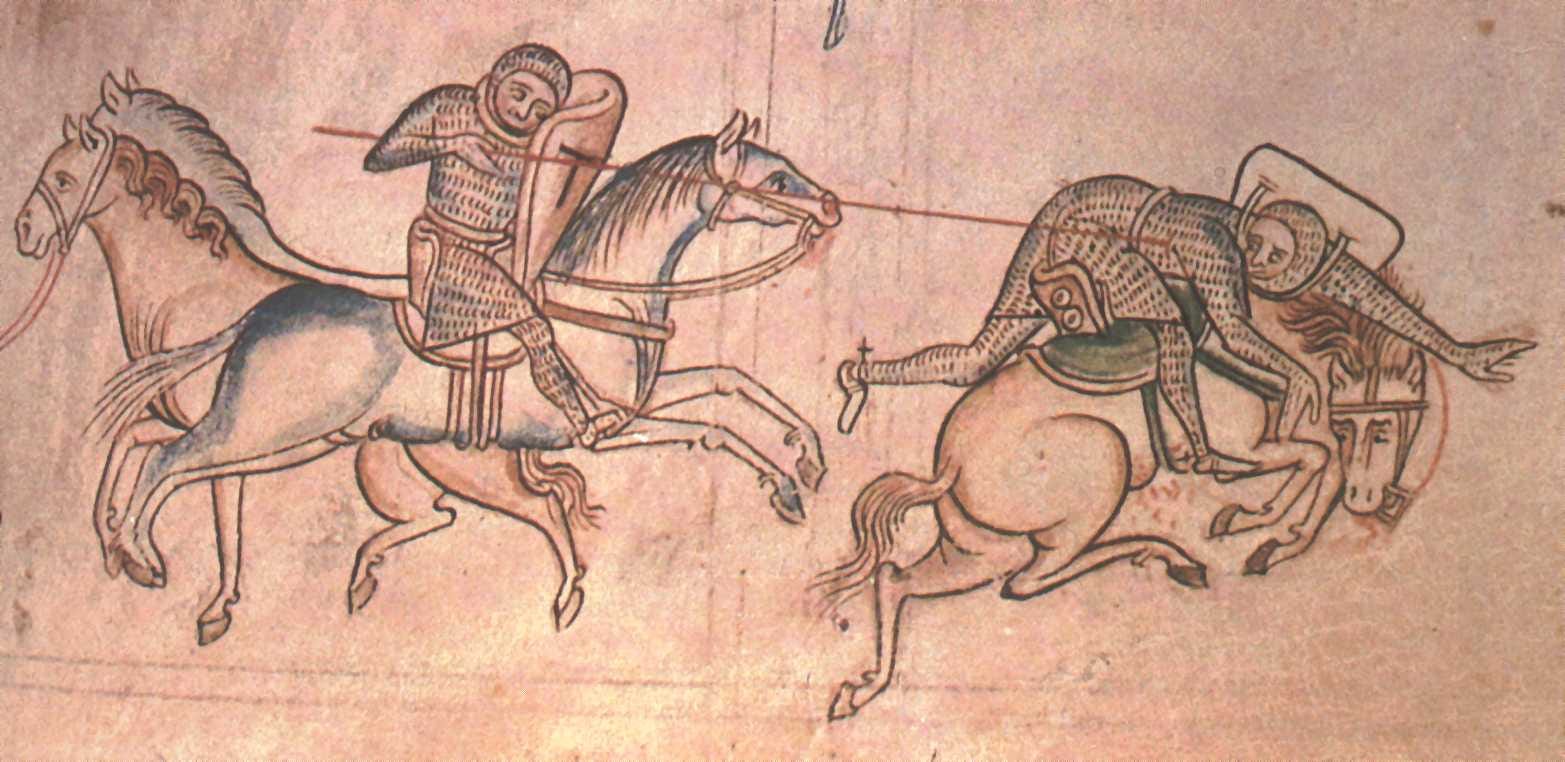
In 1168, William was part of a retinue escorting the English queen Eleanor of Aquitaine through her own territory of Poitou when they were surprised by a party of heavily-armed rebels. Earl Patrick, unarmored, was killed almost at once, but his remaining knights held the road long enough for the queen to escape. William was the last to fall, “backed up against a hedge, like ‘a boar before a pack of wolves’, desperately trying to hold back a ring of foes at sword-point. It was only when a [rebel] knight circled round to attack from behind—shoving a lance through the hedgerow that ‘went clean through [William’s] thigh and out the other side’—that he was felled.”12 The rebels dragged him with them as they fled, in conditions that made treating his wound difficult, but he survived and was even allowed enough freedom to join them in a game of “who can throw this big rock the farthest” that the History claims he won (but caused the healing wound to open again). Eventually, though, news came that Queen Eleanor was willing to pay his ransom herself, and once he was freed she gave him a place in her own military retinue.
The History reports that he now considered himself “in the gold,” and he was right: in three years, he had gone from a lordless, cloakless, warhorseless vagabond to the highest household in the realm. The true scale of his ascent became clear in 1170, when Henry II — hoping to avoid a repeat of the Anarchy and the kind of contested succession that had brought him to the throne a generation earlier — had his fifteen-year-old son (another Henry) crowned king alongside him and appointed William as the young man’s tutor-in-arms and a leading member of his mesnie.
Asbridge has some revisionist takes to offer on the Young King, who (spoiler alert) did not survive to rule independently, which is why history has not accorded him a number. I found these interesting (I imprinted hard on A Proud Taste for Scarlet and Miniver as a child and will devour approximately anything that has to do with Eleanor of Aquitaine) but not terribly germane here, so I’ll note simply that the History describes Young Henry as “the finest of all the princes on earth, be they pagan or Christian,” and that when William established a priory much later in his life the charter named the various kings he had served but described only this first master, then long dead, with the intimate “my lord.” He later followed Young Henry, his brothers, and his mother into revolt against their king, then — once the revolt was defeated and Eleanor was imprisoned — onto the tournament field.
The Young King, perhaps realizing that his father was never going to give him meaningful power, reinvented himself as the glittering and glorious “father of chivalry.” He spent his generous allowance on recruiting and supporting a mesnie of the finest knights in Europe, and the History records that “he could never have enough of risking and giving generously” and was “incapable of refusing anything to any man.” This seems to have been the period William remembered most fondly later in life. As Asbridge describes it:
The History painted a vivid picture of the exuberant joy shared by William and the Young King at their daring exploits, evoking an unmistakeable sense of unfettered bravura and camaraderie. This was never clearer than at a ‘grand and excellent’ tournament held on the Norman-French border between Anet and Sorel. Henry’s retinue performed well in the early stages of this event, timing their charge to perfection so that they ‘drove right through’ the French ranks. With their opponents in full flight, most of the Young King’s household set off in pursuit, but Marshal remained at his lord’s side. Together they ‘rode downhill until they came out clean in the middle of the main avenue in Anet’. The town seemed deserted until they turned a corner and were suddenly confronted by the sight of the mounted French warrior, Simon of Neauphle, blocking the way ahead with a well-armed party of infantrymen. The History related that: ‘The King said, “We shall not get through, and yet there is no question of going back.” The Marshal replied, word for word: “So help me God, there’s nothing for it but to charge them.”’
Hammering headlong down the street, the throng of foot soldiers scattered before them, all desperately trying to avoid being trampled to death. A way through opened up, but William was not content merely to make a getaway. He rode in towards Simon of Neauphle, deftly snatched his horse’s bridle and, holding on with all his might, began dragging his opponent along behind him, as Henry followed. This was one of Marshal’s favourite techniques — it had earned him plenty of captures back in the 1160s — and he now rode off to the lists, with Simon in tow, intent on declaring the French knight his prisoner. Simon had other ideas. As they raced through the town, with William ‘paying no attention to what was going on behind’, the French knight leapt out of his saddle to grab an overhanging gutter, and was thereby plucked from his mount. Marshal remained oblivious, but the Young King witnessed this spectacular feat, yet said nothing.
When they reached the lists and William instructed his squire to ‘Take this knight into custody’, Henry cheerily enquired in reply: ‘What knight?’ and then revealed Simon’s ‘splendid trick’. The History presented this as a comical moment: Marshal ‘burst out laughing’ as both men savoured the joke, and the tale was heartily retold for weeks to come. The episode has the feel of a favoured, and perhaps embroidered, anecdote, but the kernel of truth — William’s intimate friendship with Young Henry — seems authentic.
The golden age of chivalric bromance didn’t last: Young Henry launched a war against his brother Richard, their father joined in on Richard’s side, and in 1183 William’s beloved lord, the great flower of chivalry, died of dysentery and deeply in debt to his mercenary captains. On his deathbed, he charged William to fulfill the crusader’s vow he had made but never honored; of course William obeyed. Unfortunately the author of the History announces only that while in the Holy Land he performed as “many feats of bravery and valour” as “if he had lived there for seven years,” but “I was not there and did not witness them, nor can I find anyone who can tell me half of them.”13 When William returned to England two years later, he was offered a place in the mesnie of the Old King, Henry II, his lord’s father.
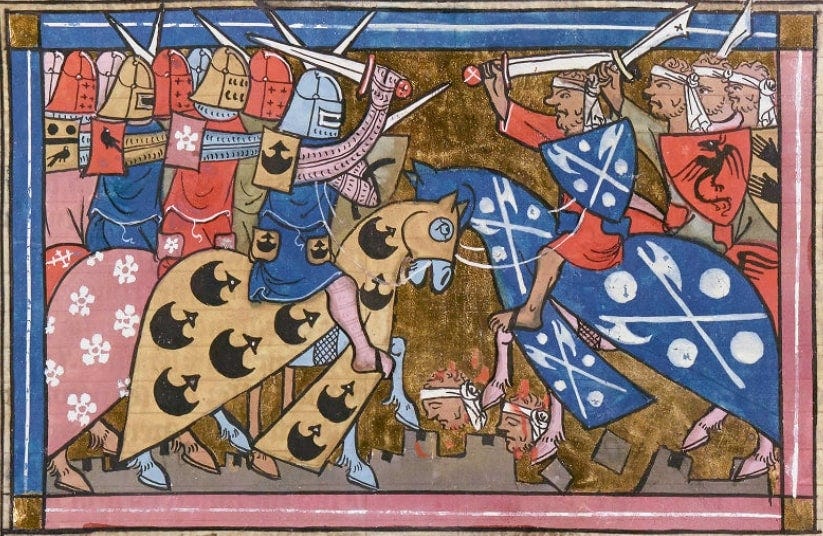
The History’s account of the following decades can best be summarized as “William Marshal serves his lord loyally even when other people are disloyal jerks and don’t, and he’s rewarded for it.” Perhaps the centerpiece comes in 1189, when the ailing Henry II was fighting yet another war against one of his sons (this time Richard the Lionheart, his heir, who had allied with the King of France), and has two parts.
The first was in June, by which point it was already clear that the Old King was dying but would not surrender. Forced to burn his favorite city to cover his retreat, Henry’s party was riding for safety when a group of Richard’s knights came up fast behind them on the road. William and another knight (another William, they hadn’t invented very many names in the 12th century) turned to bar their way when they realized that the newcomers were led by none other than Richard himself — and that Richard had eschewed shield and armor for greater speed in pursuing his father, leaving him as terribly vulnerable as William’s uncle the Earl of Salisbury had been years earlier.
The History reports that “[William] spurred straight on to meet the advancing [Duke] Richard. When the [duke] saw him coming he shouted at the top of his voice: ‘God’s legs, Marshal! Don’t kill me. That would be a wicked thing to do, since you find me here completely unarmed’,” and William, a bastion of chevalerie, replied, “‘Indeed I won’t. Let the Devil kill you! I shall not be the one to do it’,” and drove his lance into Richard’s horse instead. This split-second decision let William fulfill both sides of his chivalric obligations: he had protected his lord, as he was honor-bound to do, by ending Richard’s pursuit, but he’d done it without breaking the accepted rules of knightly behavior. On the other hand, everyone knew that the man he had left alive was about to become King of England; an increasing number of Henry’s men were defecting to Richard’s side, and here William had just killed his horse and very nearly killed him, which doesn’t tend to endear you to a future king.
The second part of the story comes less than a month later, when Henry II died betrayed and abandoned by most of his household and (most gallingly) his final remaining son, John. The History says that after the king’s death, his servants stripped his corpse and that William and the few loyal knights who were left had to find a cloak to cover the body before it could be taken to lie in state. Then, apparently, as soon as Richard had visited the body of his father, king, and enemy, he asked for William and rode out into the countryside with him:
The History preserved a dramatic record of this tense encounter. After a long pause, Richard finally broke the silence, apparently saying: ‘Marshal, the other day you intended to kill me, and you would have, without a doubt, if I hadn’t deflected your lance with my arm.’ This was a dangerous moment. Should William accept this comment, he would allow the Lionheart to save face, yet at the same time admit to having sought his death. According to the History at least, he chose the harder path, replying: ‘It was never my intention to kill you…I am still strong enough to direct my lance [and] if I had wanted to, I could have driven it straight through your body, just as I did that horse of yours.’ Richard might have taken mortal offence at this blunt contradiction. Instead, he was said to have declared: ‘Marshal, you are forgiven, I shall never be angry with you over that matter.’
And then Richard made him a rich and powerful peer of the realm overnight by giving him a rich heiress, Isabel of Clare, as a wife. The History’s message is clear: again and again William behaved properly even when the people around him didn’t, and again and again William was rewarded for it. He was severely wounded avenging the death of Earl Patrick and received a place in the queen’s household; he followed the Young King until he died and ended up with the Old King’s favor; he was loyal to the Old King when everyone else (including and especially John, whom William would also serve after Richard’s death) betrayed him, and then he became a wealthy magnate and eventually one of the justiciars left in charge of England when Richard departed for the Third Crusade.
There is, of course, a great deal more, all of which the History and Asbridge treat at length: William Marshal helped hold the kingdom together during Richard’s absence, raise the ransom to free him from his German prison, crush John’s rebellion, and retake the Norman territory lost to the French while the king was gone. (There’s a great story from this campaign in which William, age fifty, goes up a siege ladder, fells the enemy commander with a single blow, and sits on him.) Then Richard died and William threw his support behind John, which was probably a better call for England (the only alternative was the twelve-year-old son of Richard and John’s late brother Geoffrey) but a complicated one for William, whose relationship with the king degraded steadily over the course of his reign. Nevertheless, he remained loyal to the crown through the revolt that led to the signing of the Magna Carta and the subsequent invasion of England by the French: the History says that as “a man of loyal and noble heart, [William] stayed with [John] in hard and difficult circumstances” and that “whatever the king had done to him, [William] never abandoned him for anyone.”
By the time John died of dysentery14 in 1216, more than half the kingdom was occupied by the rebellious barons and their French allies. John’s heir, yet another Henry, was nine. William Marshal, by now nearly seventy, organized the boy’s coronation, became his regent, and was so eager to personally lead a cavalry charge that he almost forgot his helmet. (That charge, once he was properly garbed, won the royalists a stunning victory in the decisive Battle of Lincoln, preserving the English throne for the family he had served for almost fifty years and five kings.)15
William Marshal died in 1219 with his family around him. The History of William Marshal was probably written about five years later under the patronage of his son (yet another William), who had joined the rebel barons but been reconciled to the royalist cause under Henry III and ridden with his father at Lincoln. Sadly, none of Marshal’s five sons left legitimate heirs; the vast estates he’d amassed were split among his daughters’ families, and the History itself seems to have been forgotten:
By the end of his long life, contemporaries recognised the scope of William’s achievements — not least his defence of the Angevin dynasty and defeat of the French. For many, he was the peerless knight; Lancelot brought to life. Marshal seems to have served as an inspiration for writers of medieval Arthurian literature. Indeed, the Comte Guillaume (Count William) to whom the elusive, but highly influential, Marie de France dedicated her translation of Aesop’s Fables may well have been William Marshal. It is little wonder that, while grounded in fact, his biography, the History of William Marshal, was fashioned in Anglo-French verse to resemble an Arthurian epic. With the fracturing of the Marshal dynasty, however, that text fell out of circulation, and the associated celebration of his exploits gradually subsided. By the end of the Middle Ages, the History had been forgotten and William became merely another name in the dusty annals of the distant past.
Asbridge’s takeaway is more or less “William Marshal was an influential historical figure and more people should know about him,” which conclusion I co-sign: William played increasingly important roles in a pivotal seventy years of English history, and the stories are great. But “William died in a different England to the one in which he had been born, but it was a country that he had been instrumental in shaping” doesn’t go far enough: he helped form politics and government, yes, but also culture.
The chevalerie that shaped William Marshal’s life, the code of honorable conduct towards other guys on horses, was partly a practical outgrowth of the rules of the tournament. But it also owed a great deal to the literary tradition that was being created at the same time, and William’s biography — both the History itself and the larger story it preserved, of a boy who was nearly killed by a king but went on, through acts of peerless daring and feudal loyalty, to serve five more — became part of that tradition. His funny stories of his own life, the things he valued and remembered and obviously retold to his children and his household, aren’t just reflections of an early stage of the ideal of chivalry; they helped make it. If William Marshal was, as the History puts it, li meillor chevalier del monde — “the greatest knight in the world” — it’s at least in part because the idea of “knight” was built with him for its model. This is how culture happens: the world changes, people work out new ways of living in the changed world, and then their stories survive as ideals that other people keep trying to copy even once the world has changed again. We’re still thinking about what it means to be a guy on a horse long after the mounted warrior class was gunned down.
As a measure of the degradation of the times, the chroniclers’ English no longer employed grammatical gender.
The ⁊ is a Tironian note for “and,” incidentally, and halechen is obviously cognate with “hallowed.” Like and subscribe for more Old English in the least expected places.
Stephen’s son and heir Eustace having died by this point, it was agreed that he would keep the English throne but be succeeded by Matilda’s son, the future Henry II, who had already conquered Stephen’s duchy of Normandy.
Yes, like Beowulf. It’s depressing to realize how many incredible medieval texts survive in only one manuscript. Thank a Benedictine today!
Claim not verified by anyone who actually reads medieval French, but I didn’t see any obvious errors.
You could also, if you felt the urge, peruse the other book about William Marshal called The Greatest Knight, a historical romance novel by Elizabeth Chadwick. I will never admit to having done this but I will note that she mentions consulting the Akashic records as part of her research process.
“Enough” is a relative term; I recently noped out of the amazing-sounding No More Napoleons: How Britain Managed Europe from Waterloo to World War One after about three pages because it assumed a level of familiarity with the Flemish ports that, like a Y chromosome, I just don’t possess.
As anyone who’s ever looked at a funerary inscription for a child could have told you. But the story of the lord of Châteauroux was too good not to include.
“Did one hundred sheep mean 100 or 120” - the greatest argument in the history of history, locked by…
I don’t give a fig about realism in my historically-inspired fantasy if it gets in the way of a good story — “what was Aragorn’s tax policy” might plausibly prompt an interesting novel, but its absence isn’t a flaw in Tolkien — but I do think it’s a terrible shame to remain ignorant of things that could inspire a good story. I would absolutely read the book that was just Entourage with swords, magical or otherwise.
Yeah, yeah, the Welsh Arthur legends, don’t @ me.
Something something combat as war vs. combat as sport, my preferred RPG playstyle is historically accurate.
If you care, the rebels were Geoffrey de Lusignan and his younger brother Guy, who would go on to be the king who lost Jerusalem.
Asbridge is mostly known professionally for his scholarship on the Crusades, and was apparently the historical consultant for the execrable Kingdom of Heaven (I forgive him even though the real Balian d’Ibelin was much cooler than Orlando Bloom), so one presumes this lacuna frustrated him.
Further evidence for the “unexciting infectious diseases have had a way bigger impact on history than sexy ones like smallpox” thesis; by my count, only “murdered after being deposed” beats out dysentery as a single cause of death for premodern English kings.
I originally wrote “for the English kings,” but the question of how much more English the Angevins were than the Capetians at this point in time is an open one. I’m sure someone has written something interesting on the idea of Englishness among the Anglo-Norman aristocracy and I want recommendations.
> But when Stephen’s men told John Marshal that his son’s life would be forfeit for his treachery, Marshal is said to have replied that he didn’t care, because he still had “the anvils and the hammers to forge even finer ones.”
> History does not *specifically* record that he was grabbing his junk as he said this, but one can assume.
https://www.tumblr.com/kontextmaschine/75101381560/william-marshall-greatest-knight-in-english
Also, fascinating case of nominative determinism that the fightiest knight in England was named Marshal, Will.