

Goodnight, Goodnight, Construction Site, Sherri Duskey Rinker (illus. Tom Lichtenheld; Chronicle Books, 2011).
There comes a time in the life of every young hominin when it can toddle on its own two feet beyond adult reach and begin to interact unsupervised with its environment. Naturally, this requires a rapid and encyclopedic categorization of all diversity within that environment: the hundreds and hundreds of edible plants and animals, the far greater number of dangerous ones, the way the landscape and its riches change with seasons and weather, &c.
Or, if you take the toddling hominin out of the environment of evolutionary adaptedness and put it in a nice WEIRD climate-controlled house where food comes from about ten species1 at the grocery store and all the cool dangerous stuff is carefully hidden, dinosaurs.
Well, I was a dinosaur kid, and so was one (1) of mine — which meant I got a good excuse to catch up on the mumbledy-mumble years of paleontology I had missed2 — but for the rest of them it was construction vehicles. I have read aloud a great many books about construction vehicles. I have corrected several different mispronunciations of “hydraulic cylinder.” The first time I ever humiliated my daughter in front of her friends, she was four and I had just called a backhoe an excavator. So obviously, I can recite this entire book from memory.
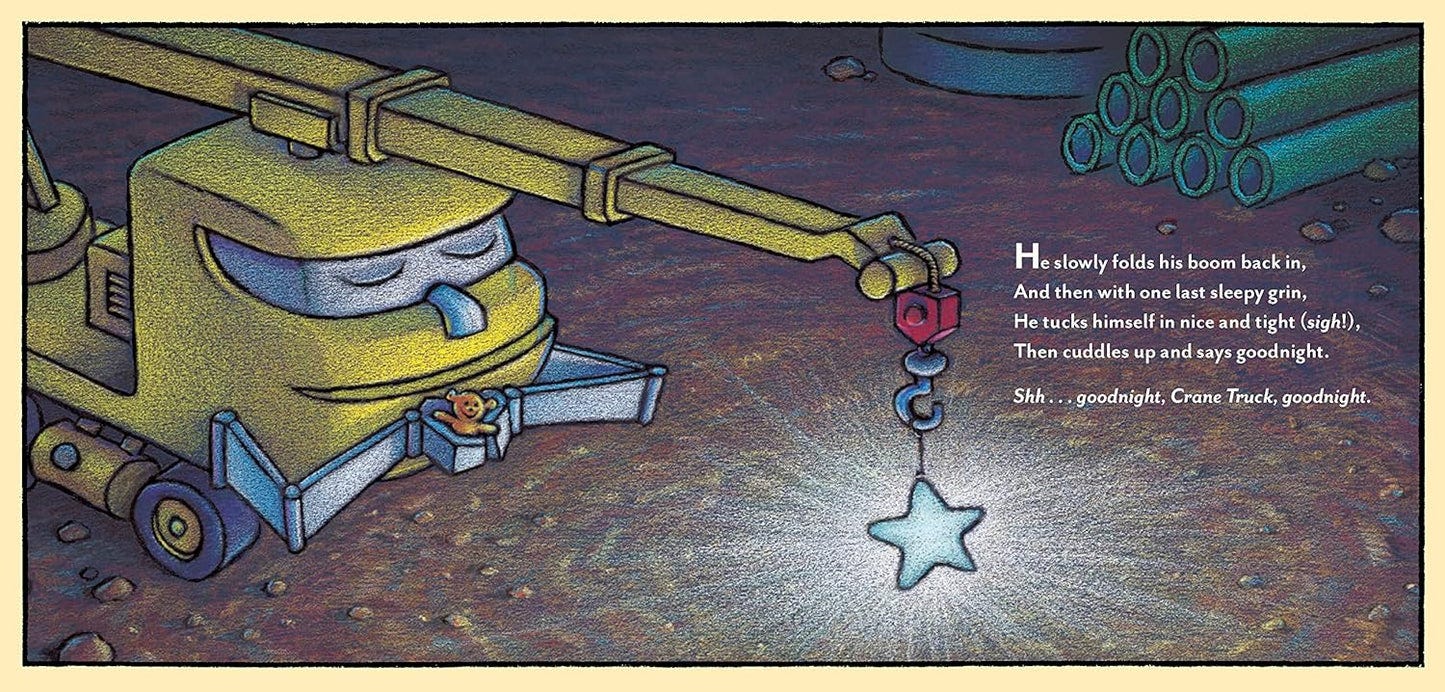
It’s a nice book. The pictures are pretty. The words actually scan, which should be a given for children’s books and unfortunately is not. The plot, such as it is, consists of a whole slew of smiling trucks (Crane Truck, Cement Mixer, Dump Truck, and so forth) finishing their “rough-and-tough construction play” and going peacefully to bed beneath the moon. (The quiet hope is of course that the small child on your lap will emulate the trucks instead of getting up in five minutes to see if the big people are doing something interesting like eating ice cream or having an uninterrupted conversation.) The sunset colors of the illustrations are eye-catching without being lurid, the truck characters manage to strike the right balance between realism and friendly anthropomorphism, and my toddler loves to point out Crane Truck’s teddy bear. So I really do hate to be a pedant here when I point out that trucks do not, in fact, go to sleep. The people who operate trucks go to sleep. Trucks are like guns in this way.
Now, obviously one of the delights of picture books is that they don’t need to accurately represent reality. To pick on a few classics, you can’t actually enter a drawing, a bull who refused to fight the matadors would not be peacefully returned to his field, and I wouldn’t bet on the continued welfare of a child who took the place of a bear cub. Smiling trucks with teddy bears have nothing on being baked inside a cake for fantasy! And this particular brand of fantasy — look, toddler, this character who’s not actually a small child is just like you — has a long, proud history in children’s literature because kids love it. (See also George, Curious.) There don’t have to be people in Goodnight, Goodnight, Construction Site because the trucks basically are people.3 Fine.
And yet.
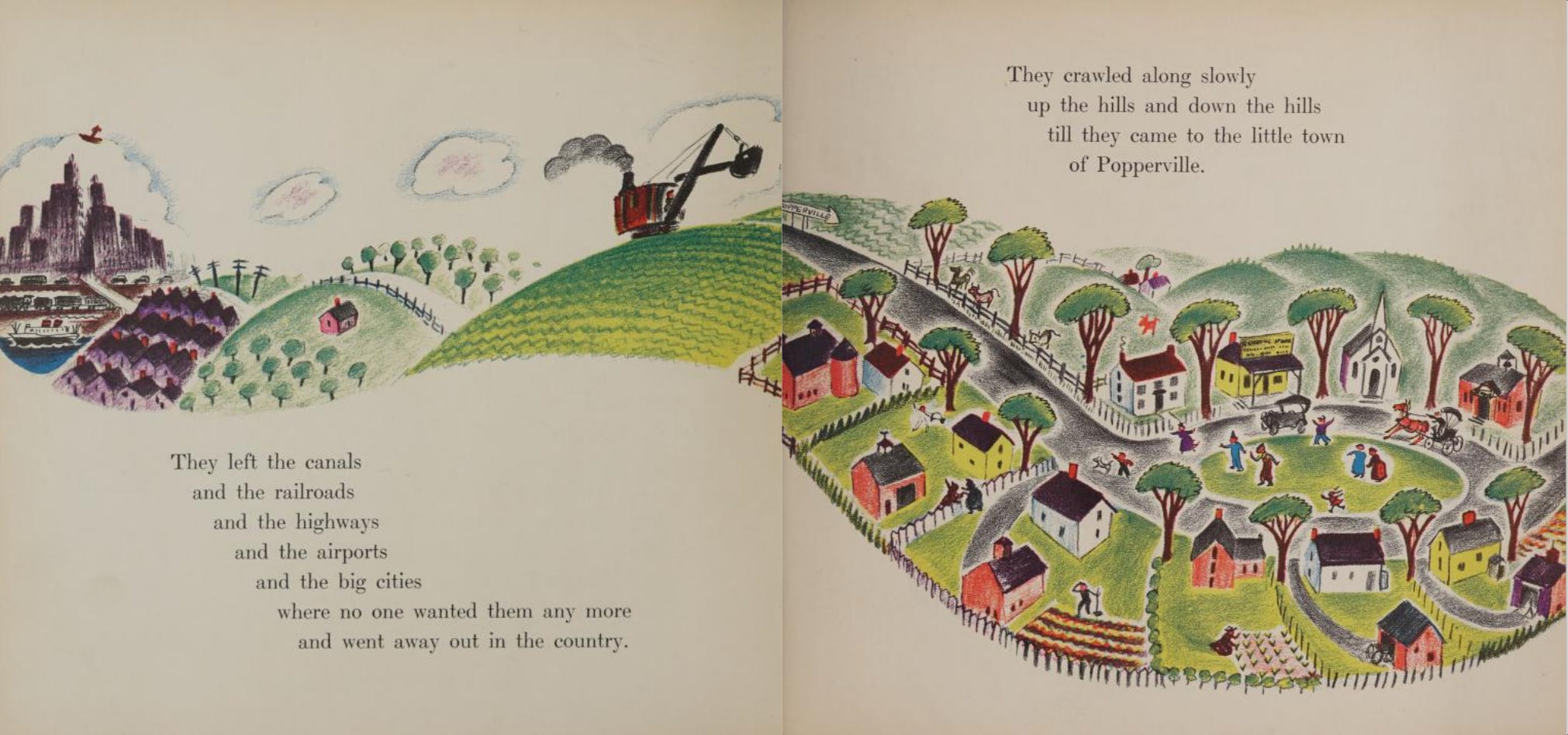
If I wanted to be Marxist about it, this is where I would start talking about the wholesale replacement of labor by capital in our collective imagination. It’s not enough that most live human activity is no longer economically viable without constantly suckling at the teat of coagulated labor — you could, I suppose, build a house entirely by hand and paid for with only cash, but it’s so impractical as to be virtually unheard-of — now we’ve removed any human actors from the picture entirely! And we didn’t have to: Mike Mulligan and His Steam Shovel manages to be a charming and deeply humane story about construction vehicles without ever losing its focus on the actually interesting part, which is people and what they do with their machines. And yes, my tongue is a little bit in my cheek here (though I maintain that one of the secret joys of parenthood is the opportunity to develop increasingly deranged literary analyses of children’s media).4 But think for a moment about what it’s like to be a kid in the Year of Our Lord 2026.
I do a lot of the same things my mother did a generation ago. I play music. I read books. I look up the answers to my children’s questions when I don’t know them off the top of my head. I send pictures to various relatives who like to see how cute they are. I order pizza delivery on evenings I’m going out. But when I was little, these were all clear and distinct endeavors. To put on music, my mom had to open the little plastic box that held the cassette (yes, I’m old), slot it into the machine, press a button, and occasionally fiddle with the reels if someone had been fascinated with unspooling that shiny brown tape. To send a picture, she put physical photo prints in a paper envelope and wrote an address on the outside with a pen. To order pizza, she stood in our kitchen in her date night dress and heels and a cloud of freshly-applied perfume, springy telephone cord stretched across the room, and spoke to a human being.
Today all these things look the same. Whether Mom is putting on music, sending a photo, reading a book, or ordering pizza: there she is, wherever she happens to be, head bent over a shiny black rectangle, poking it with her fingertip.
Obviously I could retvrn to the way we did all these things back in the 1900s, and just as obviously I’m not going to, because every one of them has been improved. Spotify has a better catalog than even the most capacious music collection, my kids’ grandparents get way more photos of them than mine ever did of me, I read far more on Kindle than I would if I had to carry a physical book around with me, and I never have to spell my surname for DoorDash. (You have no idea how difficult people find “Psmith” over the phone.) But the price of those improvements is opacity.
Lots of things are complete mysteries to children. This is in some sense the defining feature of childhood! Which means that, after keeping your kids alive, your biggest job as a parent is explaining these mysteries (or at least putting your kid’s feet on the path of figuring it out for him or herself). The more complicated the world gets in our attempts to improve it, the more specialized and alienated any individual part of it becomes. I can more or less mentally model the supply chains that go into running a pizza restaurant, and I have a very vague idea of how a national telephone system works (I think it involves whistles), but I could not begin to tell you anything about the distributed payment architecture involved in operating your burrito taxi. As the world gets simpler on its surface — Mom’s finger, glowing screen, dinner — it gets increasingly complicated beneath until it all looks like, well, magic.
Of course, when you’re three years old, seeds turning into plants also looks like magic (as does dinner turning into you + things we don’t discuss at the table). But technology is special because it’s a kind of magic you can control.5 Every single step of the invisible process that kicks off when you ask your mother to put on “In the Hall of the Mountain King” for the umpteenth time and culminates in sound waves entering the air of the family room — from the WiFi protocol to the decryption key to the speaker’s magnet placed just so — has been specifically designed by human beings for human purposes, whether you know it or not. It’s as though you were born into a world of incomprehensible spirits and then learned that in fact your forebears had created them and that with the correct mystic incantations you could also bring them under your control. How exciting! (Unfortunately it’s famously difficult to see invisible things, which is why a grown adult recently asked me why Netflix employs software engineers, can’t they just put the movies online.)
Which brings me back to trucks.
The modern home contains very little productive activity, and what remains tends to be either recreational (the output of my vegetable garden and sewing machine could be obtained far more cheaply elsewhere even if you value my labor at $0) or opaque (executives really do need dashboards that give them deeper insights into critical business functions but typing doesn’t look like much). Most of the places the modern toddler goes are even worse: a child may see lots of adults providing services, but we’re so industrialized that anything being recognizably made is tucked away where the noise, smell, and dangerous moving parts can’t bother anyone.
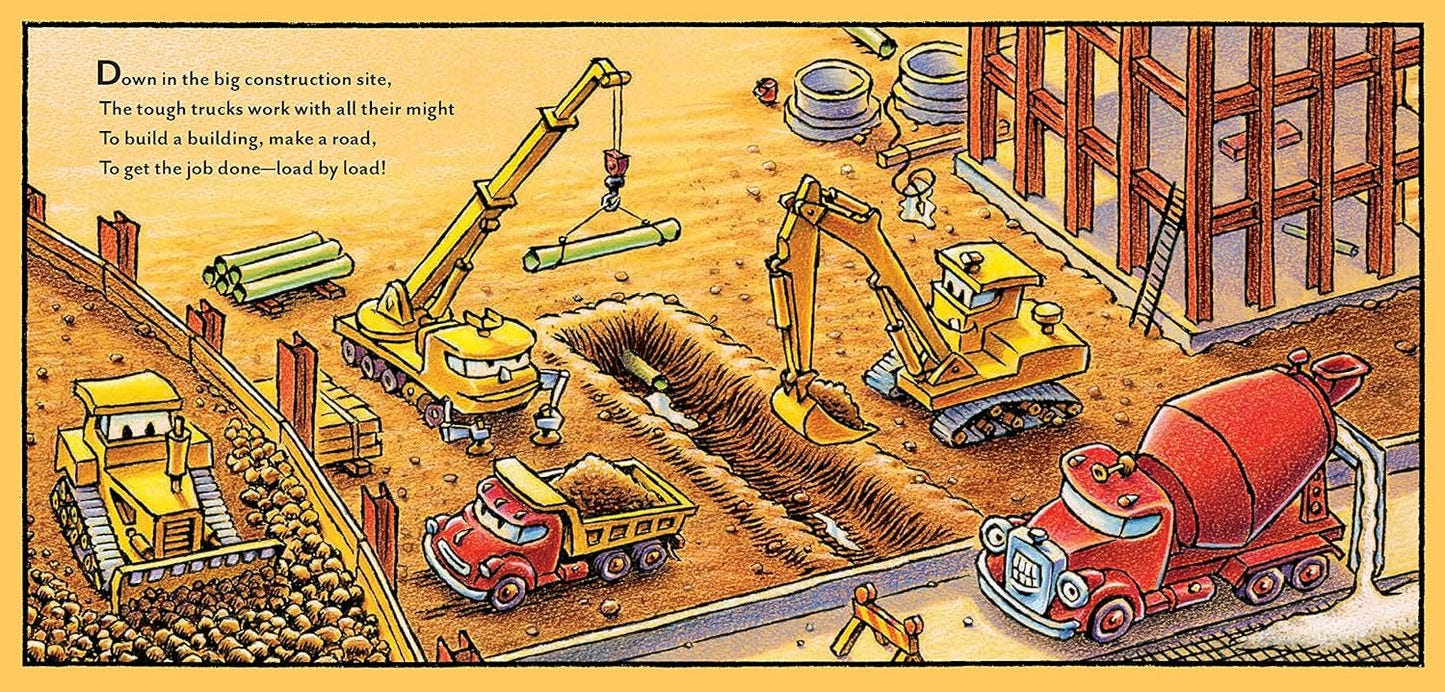
The construction site is one of the few exceptions. By its very nature it can’t be put somewhere else, which makes it an exciting locus of activity and agency. Here are men doing the very same kinds of things a toddler loves to do — digging holes, stacking objects, wearing funny hats — on a massive scale, using enormous cool-looking machines. Here’s noise and movement and color taken seriously, as work rather than play. Here’s the human capacity to inscribe our presence on the world, shockingly realized as it is virtually nowhere else in the child’s lifeworld — and this 230-week New York Times bestseller is handing over our birthright to the trucks. There’s no operator for the crane. There’s no driver for the dump truck. The transparent windshield that lets the worker see the world has been converted into the eyes of an anthropomorphic vehicle. The one remaining place where small children can see people do things has been reimagined as a place where, like the music and the pictures and the pizza, things simply do themselves.
And the worst part is, it’s not even wrong.
A year or two back, one of my kids was extremely taken with a video shot from the backseat of a Waymo and immediately analogized to the SpaceX booster catch we watched a few days later: “Look, Mama, the rocket is self-driving itself!” I tried to explain that, well, in some sense yes, it’s behaving autonomously, but people wrote the software that controls its movements just like people wrote the Waymo code. And then last week Claude Code took a one-line prompt — “my daughter wants a game where you fly a dragon around” — and produced something they’ve been competing for top scores in ever since. Well, I coped, LLMs are written by people too. Or at least the training harnesses are, right? Except when they’re written by LLMs, I guess. But if you learn the right incantations you can still control them! For now!
Goodnight, Goodnight, Construction Site is a cute book. I’ve read it three times so far today and I’ll undoubtedly read it again this evening with a pajama-clad toddler in my lap. The precise thing I found faintly ominous last kid ‘round — the replacement of humans by something friendly and vaguely human-shaped that does all the cool stuff humans used to do — turns out to be the perfect preparation for the world my children will face. Who’d have thought the most prophetic sci-fi dystopia would come in a fifteen-year-old picture book?
Shh. Good night, human face. Good night.
Cows, pigs, chickens, corn, wheat, apples, bananas, tomatoes, potatoes, clementines.
You can too, no children required; I highly recommend The Rise and Fall of the Dinosaurs: A New History of a Lost World to all former dinosaur kids and anyone else for that matter.
Have you ever thought seriously about the world-building of My Little Pony: Friendship is Magic? By rights it should be a magocracy as horrifying as anything in Dark Sun.
Okay, fine, we can also exercise control over plants and human bodies, that was a pretty significant thing that happened.
I’ve got teenagers and I think all the time about how hypocritical it is to tell them “I don’t want you on your phone all the time, but I need to be on my phone sometimes.”When I am definitely doing things on my phone that don’t need to be done a lot of the time.
When tasks weren’t all consolidated into the black box you also had a sense for what your parent was actually doing. You watched your parents pay the bills, you heard them making appointments, you interacted with their friends as they “just dropped by to chat”. All of that is gone.
As someone who *also* has this book memorized, and is now working on AI Policy in the hopes that my child can read aloud to his children someday, the last paragraph was disturbing. Uh, well done, I guess?