
REVIEW: An Amish Paradox, by Charles E. Hurst and David L. McConnell

An Amish Paradox: Diversity and Change in the World’s Largest Amish Community, Charles E. Hurst and David L. McConnell (Johns Hopkins University Press, 2010).
Sometime in the 1970s, modernity finally came for the Amish. It didn’t arrive in cars, which they still don’t drive, or through the schools, which they still leave after 8th grade, or even over the telephone. Instead, it came the same way it’s come for everyone else since the Industrial Revolution: through grinding, inexorable economic logic. In this case, the proximate culprit was high Amish birthrates. If your population roughly doubles every generation, and you think it’s important to stay put and live near people like you, land gets scarce fast. (Meanwhile, your neighbors who haven’t built their lives around unmechanized agriculture are urbanizing and industrializing, which drives prices up still farther.) Soon Amish parents found they couldn’t afford to do what their parents had done and establish their children on farms of their own. It seemed like an existential threat: in a 1980 article in Rural Sociology, Amish scholar1 John Hostetler warned that those who “cannot obtain a farm may find it hard to remain Amish.”
But he was wrong. Yes, a few of the most conservative Amish did pick up stakes and move to cheaper areas so they could keep farming, abandoning the “living around mostly other Amish” part of their lifestyle rather than the agriculture. In the densest parts of “Amish Country,” however — in Indiana, Pennsylvania, and particularly in the settlement which centers on Holmes County, Ohio — an enormous number of Amish found other ways of making a living. Over the last few decades they’ve gone to work at local shops and factories, doing everything from welding and powder-coating to making garage doors and harnesses, or started their own businesses selling handmade goods like quilts, fences, baskets, and especially furniture. If you’ve ever gone looking for affordable solid-wood furniture, you’ve certainly found websites selling Amish-crafted computer desks and media centers, and those e-commerce platforms may well have been installed and maintained by the Amish carpenter himself (or his wife or one of his children). And they’ve stayed Amish! Nearly ninety percent of Amish children eventually join the church,2 and a 2002 study suggested that retention rates may actually be higher in non-farming families than among those who maintained their traditional lifestyle.
All of which seems counterintuitive to us “English” (the Amish term for all non-Amish, regardless of actual ethnic origin). Aside from people who grew up near Amish country, we generally have a vague sense of the Amish as a people frozen in time, with picturesque bonnets and straw hats and horse-drawn buggies and communal barn-raisings, whose most notable cultural feature is their total aversion to modern technology. An Amish person riding in a car, or using a CNC machine, or making a website, strikes many English as hypocritical: don’t the Amish think those things are bad? Don’t they think we shouldn’t use them, either? (And sometimes, around the edges, for the more Prophet-minded of us: gosh, wouldn’t it be nice if we didn’t?)
But like everything it’s more complicated than that, and so this book, a guided tour from a sociologist and an anthropologist at the College of Wooster (just a short drive north of the Holmes County Settlement), gives a fascinating look at how different groups of Amish have adapted to these new economic conditions — and how it’s turning out for them.
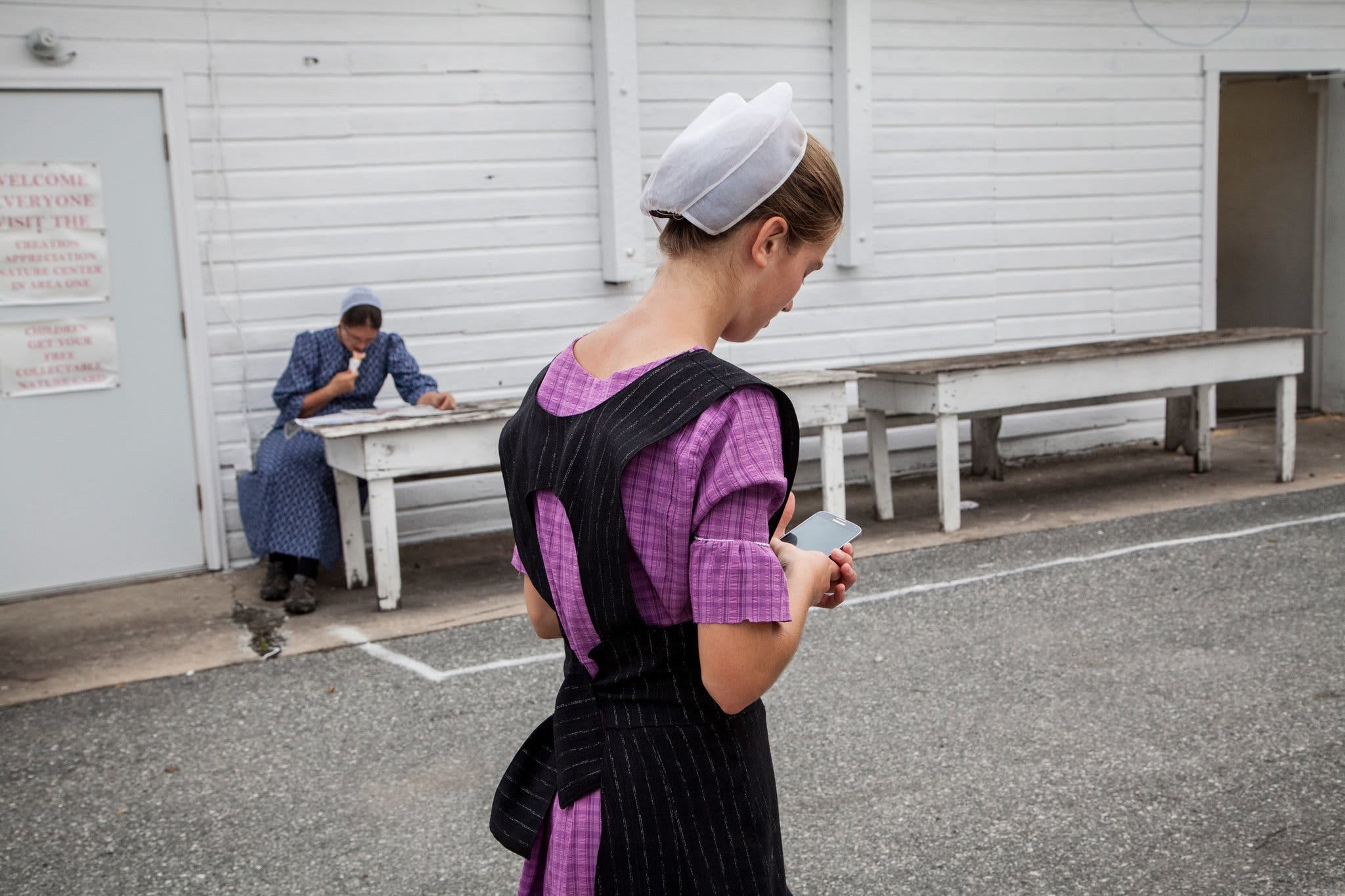
The Amish have their historical roots in the Swiss Anabaptists, a Radical Reformation movement who believed in adult baptism, pacifism, and total separation of church and state. (Unsurprisingly, the Anabaptists were bloodily persecuted by both Catholic and Protestant rulers for their refusal to accept conscription, swear oaths, or pay taxes.) And then in 1693 the Anabaptists had a schism, as Protestant sects are wont to do, over the question of how to deal with excommunicated members: one side of the argument, led by Jakob Ammann, advocated not just for exclusion from communion but for total shunning in everyday life. When he lost, he and his followers split off, and their branch was known after him as the Amish. Many of these early Amish joined the broader wave of German immigration to the United States, with five hundred settling in Pennsylvania in the 1700s and a larger group arriving in the early 1800s. Those who remained in Europe were eventually absorbed into other Anabaptist and Protestant denominations, but on the American frontier the Amish maintained their cultural identity: alone among the German immigrant groups, they still speak Pennsilfaanisch-Deitsch, or “Pennsylvania Dutch,” a dialect derived from Palatine German. (They mostly also speak English, and their church services are conducted in standard High German.)
The basic organizational unit of Amish society — after the extended family, which is vital and often includes three generations under one roof — is the “church district,” a community of twenty-five to forty families who live within a short buggy-ride of one another. The leaders of the district are chosen by lot from among the married men, and each is governed by an Ordnung, an unwritten set of rules laying down expectations for behavior. It’s this Ordnung that contains the restrictions on technology and lifestyle that we typically associate with the Amish, covering everything from what color you can paint your barn (one group insists on red because white would be too worldly) to whether you can use mechanical milking machines. The church revisits their Ordnung every six months or so to see if it needs updating — one group had originally approved walkie-talkies for communication while hunting, but then discovered boys were using them to flirt with girls and decided to ban them. Church districts with similar Ordnungs are “in fellowship,” and a cluster of districts in full fellowship with one another are an “affiliation.” (A “settlement,” like the Holmes County Settlement, is a cluster of geographically contiguous districts regardless of affiliation.)
Importantly, few of these restrictions are based on the idea that the banned technology or behavior is wrong in and of itself: for instance, every Ordnung forbids a baptized Amish adult to own a car, but boys from some Amish families have cars for a while in their teens and all but the most conservative affiliations will pay someone else to drive them if they need to go farther than their buggy can take them. Or to put it another way, nobody thinks the English are bad people for driving cars — they just think we’re not Amish.
So if an Ordnung mostly isn’t meant to keep you from doing intrinsically evil things, like murder and adultery and blasphemy, what is it for? How do you decide what to allow? What are you optimizing for when you design it?
Two things, mainly, though they’re not neatly separated. The first and most important role of the Ordnung is engendering the virtue the Amish call Gelassenheit. There’s not a perfect English translation for the German,3 but Hurst and McConnell describe it as a spirit of “selflessness, humility, or meekness,” a subordination of self to community. Amish scholar4 Donald Kraybill wrote that Gelassenheit is meant to develop a “yielded self” that “stands in contrast to the bold, aggressive individualism of modern [English] culture.” Thinking too highly of yourself, or trying to outdo others, are failures of Gelassenheit, but they’re hard to avoid when you have to market your personal #brand or compete in the marketplace. Unmechanized agriculture, on the other hand, was very good at nurturing Gelassenheit: a farmer is necessarily aware of his dependence on natural forces beyond his control, which keeps him humble. Nowadays the Amish worry that shifts way from their traditional lifestyle will “foster the notion that the worker controls his or her work and life,” which might “breed an attitude of self-sufficiency, even arrogance” that is antithetical to their values.
The concern for Gelassenheit shows up particularly in Amish approaches to childrearing. Where English society values self-expression, intellectual curiosity, and individual accomplishment, Amish parents rank obedience and self-control as the most desirable qualities in children. (More than half of the parents the authors surveyed put “being interested in how and why things happen” at the bottom of their list.) They also report that teachers at Amish schools tend to be “preoccupied (to our eyes) with minor aspects of misbehavior that signaled nonparticipation in the group or lack of obedience to authority.” All of this carries through into the workplace, too: the Amish generally think white collar workers are “out to make the big bucks” and that their jobs are be difficult or impossible to undertake with a “meek spirit.” So if you can’t farm (and increasingly you can’t), the Amish think your work should be something near home that uses your hands, allows your family to participate, and contributes directly to your community. No arguments here that building dashboards to give executives deeper insight into critical business functions leads to the more efficient allocation of global capital and lifts all boats; they want you to make food or furniture or something.
The Ordnung’s second goal is to separate believers from the broader world. This is partly a legacy of the Anabaptist experience of persecution, partly a response to Biblical passages like Romans 12:2’s warning not to “be conformed to this world,” and partly a protective measure against a world that isn’t interested in Gelassenheit, but the dualism between Amish and “English” is a vital part of what it means to be Amish. Of course, it’s impossible to clearly differentiate between things that promote a particular mindset/virtue and things that mark you out as different: the distinctive Amish “plain dress,” for instance, both limits opportunities for vanity and marks out the wearer as, well, kind of a weirdo. (There’s sometimes also a sub-goal of separation from other Amish affiliations — one Amish man is quoted saying, “The only reason the Old Order doesn’t have rubber wheels [on their buggies] is because the New Order did it first.”)
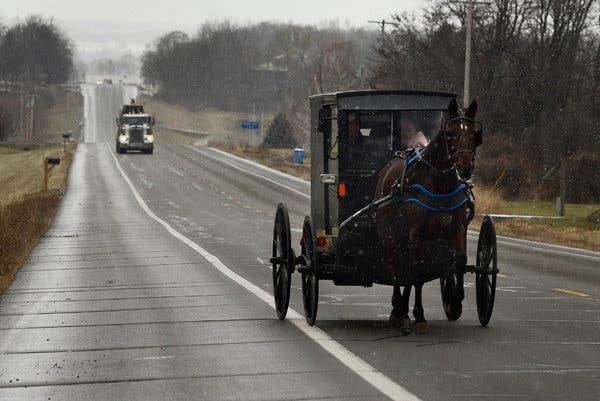
The Holmes County Settlement contains four main affiliations (with a few smaller ones splintering off at the edges).5 In 2009, about two thirds of the 221 church districts were Old Order, what you might consider mainstream or “vanilla” Amish. (Smaller settlements tend to be even more heavily Old Order, because it’s hard to perpetuate your schismatic group without critical mass.) The Old Order Ordnung is surprisingly lenient in some areas, though: their farmers use tractors to plow, their dairymen use milking machines and mechanized coolers, and Old Order businessmen run electric tools off diesel generators in their workshops and factories. “I have 15 Old Order customers,” a lumberman told the authors, “and I can call every one of them by cell phone.”
The Amish use the terms “low” or “high” to rank affiliations by their worldliness, with “the world” at the metaphorical top, and one step down the ladder from the Old Order are the Andy Weavers. Their split from the Old Order, back in the 1950s, was over a disagreement about an Amish man who stopped going to church and bought a pickup truck: the traditional consequence would have been complete social ostracism from Amish society, but a good half of his district argued that exclusion from communion was sufficient. Those who disagreed with this lax interpretation of shunning followed a young church leader named Andy Weaver into schism and their own affiliation, and in 2009 there they had about thirty church districts in Holmes County. Until the 1980s the main difference between them and the Old Order was their hard line on shunning, but more recently they’ve imposed more restrictions on technology — or, in some cases, haven’t loosened restrictions the way the Old Order has: Andy Weaver dairy farmers got out of the business entirely when it became impossible to compete without milking machines, and they’ve banned parents from allowing their unbaptized children to own cars while living at home. (Some Old Order families, by contrast, do most of their travel in the car of whichever teenage son is currently old enough to drive but not old enough to join the church, only breaking out the horse and buggy to go to church on Sunday.) Still, although the technological differences loom largest to the English, the Amish consider the approach to shunning a much more important and fundamental disagreement: the Holmes County Andy Weavers are still in fellowship with the Old Order of Pennsylvania’s Lancaster County, who may be technologically progressive but who are still stricter shunners than the Old Order in Ohio.
The very “lowest” Amish affiliation is the Swartzentrubers, who had nineteen Holmes County Settlement church districts in 2009.6 Unlike the other affiliations, who mostly chose to stop farming so they could stay put, the Swartzentrubers tend to move in order to keep their lifestyle, so they now have at least sixty-five church districts spread over twelve states and Ontario. (They’re hard to count, though, because they refuse to participate in any of the Amish directories.) Though they also originated in frustration with Old Order laxity on shunning (this time in 1918, and a rather less lax laxity), today they’re most notable for their stubborn rejection of virtually all modern conveniences. They refuse to use “fast time,” remove the indoor plumbing from any house they buy (everyone else just drywalls over the electrical outlets to maintain resale value), won’t put linoleum on their floors, and accept rides in other people’s cars only in the direst emergency. They even refuse to put reflective orange “Slow Moving Vehicle” triangles on the backs of their simple, windowless buggies, which has led to more than one fatal accident when trotting along the highway at night.
The final major affiliation is the New Order, which — as you can probably guess from the name — is one step “up” from the Old Order. They do, of course, have practical differences from the Old Order (their buggies tend to be a little flashier, their men groom their beards more neatly, they sometimes have telephones in their homes but they won’t own cell phones) but again, the real difference is one of religious practice. Unlike the more conservative affiliations, however, the New Order split with the Old over the question of the believer’s personal relationship with God. Where the lower Amish emphasize “submission to the corporate community of believers,” the New Order take an approach more reminiscent of evangelical Protestantism. Their religious practice, full of Bible studies and personal testimony of salvation, is foreign to the rest of the Amish: “You couldn’t get the average Old Order man out on the street to give you a strong faith story,” one Old Order man explains.
But the most dramatic difference between the New Order and everyone else is their approach to their young people. So far I’ve described something that sounds like a conservative/progressive spectrum, from the lowest affiliations’ highly restrictive rules about technology and intense shunning practices to the highest affiliations’ more permissive Ordnungs. And that’s not entirely wrong, but “conservative” doesn’t always mean what you’d assume. The more conservative the affiliation, for instance, the more likely the teenagers are to smoke, drink, listen to music, and even engage in the traditional practice of bed courtship or “bundling”:
In bundling the youth retire to the girl’s bedroom, where they lie on the bed—the girl in a special, more colorful “night dress” and the boy clothed, but sometimes with his shirt off—until just before the family awakes. An ex-Swartzentruber woman describes the scene: “After the parents are in bed, the guy shows up, and he sneaks in. Even though they know he’s there, facing them is supposed to be embarrassing—you know, like when you first date, you’re kind of shy meeting the parents the first time—so somehow you’re supposed to do this in secret.” Sometimes the couples will be joined by friends and will eat snacks and talk until the boys “escape” just before dawn. Hugging and kissing sometimes occur, but sexual involvement is supposed to be off-limits.
The New Order, with their emphasis on personal rather than corporate holiness, rejects all of this, and expects even their unbaptized young people to behave in accordance with the Ordnung. They also tend to homeschool their children if they can’t find a private Amish school they like, arguing that this allows for what the authors describe as “a more self-conscious articulation and deeper understanding of the values on which Amish community rests.” (The other affiliations regard this with great suspicion, considering homeschoolers arrogant “know-it-alls” who are “a little extreme on family” and disregard the lived experience of community; if they don’t choose a parochial Amish school, other Amish will send their children to public schools as an exercise in Gelassenheit.) “Conservatism,” when it comes to Amish affiliations, has more to do with continuing to do things the way the Amish have always done them than it does with anything the English world would recognize as “right-wing” — where else would you talk about how your neighbor is more conservative, so he sends his kids to public school and lets his teenager schlep beer to the kegger in his hot-rod?7
But the real question is, does the New Order approach work? In one sense yes: everyone agrees that most New Order teens don’t drink, smoke, or do drugs, and thanks to the emphasis on “clean” courtship their rate of premarital sex (as measured by the elapsed time between a couple’s marriage and the birth of their first child) is only a third of the Old Order’s. But in another sense, we might consider an Amish affiliation’s “success” to be the rate at which their young people choose to be baptized and join the church, and here the New Order struggles. In 2005, a whopping 97% of twentysomethings from Andy Weaver families had joined the church, trailed by 86% for the Old Order and a mere 60% for the New. (Since the Swartzentrubers don’t participate in the Amish directory their numbers had to be estimated by insiders, but it was probably around 90%.)
The lower affiliations attribute their high retention numbers to their children’s period of rumspringa, or running around: a few years of driving, drinking, and dancing to the radio — or even flying off for a snowboarding vacation, depending on how wealthy and accommodating the parents are — lets them get it “out of their system” before they settle down. Otherwise, they argue, their children might be too busy wondering what they’re missing to be satisfied with the Amish lifestyle. Of course, these worldly entertainments are almost always pursued in the company of other Amish youths on rumspringa, with the widespread general understanding that most if not all of them will eventually “put the car away” and be baptized. The young people may not be subject to the full weight of the Ordnung’s restrictions on technology, but they are still living in a community-minded society of “yielded selves.” And perhaps that’s the real reason the New Order are less likely to stay: their approach to personal spirituality and family identity aren’t so different from non-Amish conservative Protestant homeschoolers. As Hurst and McConnell put it, “[New Order] young people who move up a step have only to acquire a car and electronics rather than a whole new mindset.”
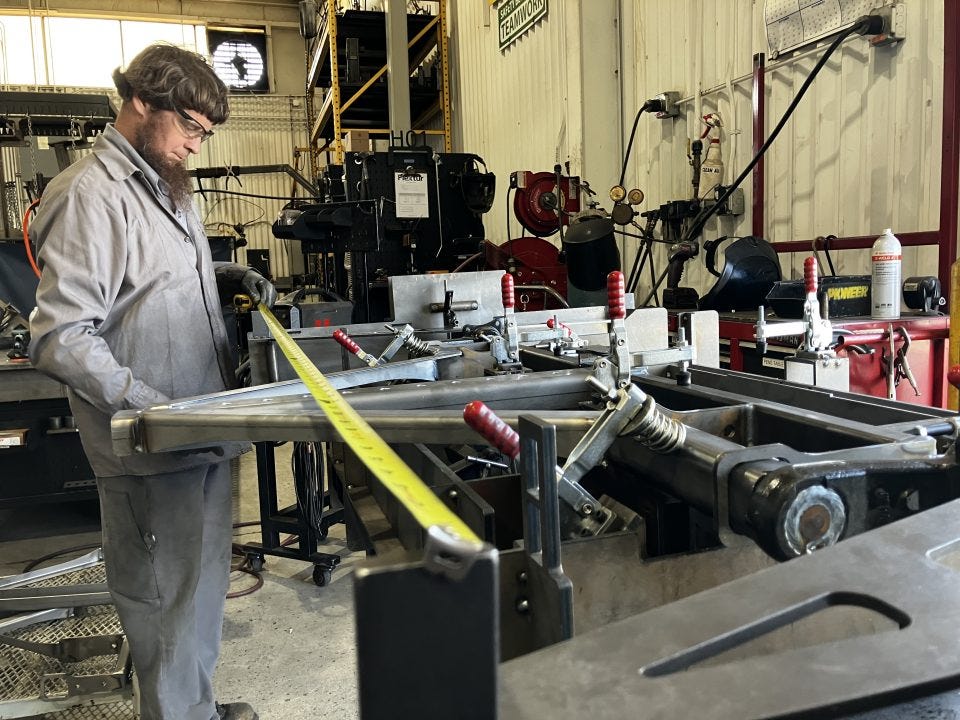
As economic pressures pushed the Amish off their farms, they found themselves in the same situation as the rest of the modern world: the whole-day, whole-family enterprise of unmechanized agriculture gave way to the familiar dichotomies of wage labor and leisure, public work and private home. But those thick extended families and deeply-held values of Gelassenheit and communal identity, not yet eaten away by liquid modernity, gave them a push to seek out or create work that preserved the parts of farming that were particularly conducive to living an Amish life. Some of the most successful Amish enterprises, like furniture workshops and landscaping nurseries, involve both spouses (and the older children!) in various roles, and in Amish country even English employers tend to recognize that they need to give to their workers the flexibility to nip home if something needs to be done. Still, those who are less lucky or less high-agency (especially Amish wives now pushed into a housewife role and husbands separated from their formerly tight-knit families all day) have suffered from the new separation of their worlds. By and large, though, they’ve held onto the deep core of what it means to be Amish despite changing lifestyles — and since they mostly ban smartphones, this is the rare book about social and technological trends in 2010 that’s still applicable today.
I originally picked it up because I was interested in the ways our technological choices shape who we are and how we live, and I thought the Amish might be a good case study of how to pick and choose among them (or even opt out of some things entirely). As I read, though, I had the sinking realization that it doesn’t work that way. Consider, for example, the Andy Weavers, who have opted out of not just milking machines but tractors, portable generators, hydraulic power, balers, bicycles, power lawnmowers, garden tillers, freezers, and computers. Aside from a few who can make a living selling organic produce at a premium, they’ve almost all left the land to work in factories and shops. The Old Order, on the other hand, are much willing to use those when it makes economic sense, so they’re much more likely to still be farming. (Ironically, a harder line on technology means a less obviously traditional lifestyle.) And yet the Andy Weavers and the Old Order, while not in formal fellowship in Holmes County, are happy to socialize and share schools because they see themselves as having much more in common than either does with the Swartzentrubers (who have refused to compromise at all with the modern world) or the New Order (who embrace a more individualistic approach to their faith), even though from a technological and lifestyle perspective the Old Order and the New Order are much closer. The real issue isn’t what you choose to do, it’s why you choose to do it.
Sure, you can decide that using a dating app (or watching short form videos, or having ChatGPT do your homework) is bad, and you don’t want to do it any more. You can absolutely get rid of your phone (or your car), and you can refrain from giving one to your kids. But if you want to build a sustainable life without the thing you’re against, you need a strong understanding of what you’re for. It’s not enough to read The Anxious Generation and decide that Science (which you Fucking Love) says kids shouldn’t have phones — you also need to know what kids should do, and why. And then you need to find a bunch of other people who agree so your kids can all do it together. A social world built around eschewing a particular technology just won’t hang together unless you have a shared vision of the good thing you’re trying to preserve or create by not using it, and your own personal use or non-use becomes far more sustainable when it’s part of your community membership. My local mom list features regular posts by nice secular Haidt-pilled ladies looking for low- or zero-tech schools for their kids, but they always go away dejected and wondering why all the schools are Christian. Well, that’s why.
But maybe you don’t even need to share the “no” if you share enough of the “yes.” After all, the Amish who have succeeded at keeping what matters to them in a changing world — their children chief among them — have done it because they have a strong shared commitment to something both communal and profoundly countercultural. Even when they’ve employed wildly different means in pursuit of their shared telos, they’re still united in a fundamentally recognizable project of Gelassenheit and corporate spiritual submission. It’s not a project I envy — I obviously think “being interested in how and why things happen” is important, and I don’t particularly want my kids to have a “yielded self” (except when I tell them to do something) — but it’s an important reminder that people can pursue a joint why even if they disagree on the specifics of how. My friends may be more or less evenly split between people who want their kids to diagram sentences in cursive on blackboards (because dry-erase markers are spiritually empty) and people who want to send their kids to Alpha School (but only until the book from The Diamond Age becomes available), but we all share a conviction that education is soul-molding more than it is box-checking.
Is that enough? Well, it depends on what you’re trying to mold the soul into, because some practices are just not compatible with some teloses.8 Still, I’d rather be in a community with people who have made different prudential choices in pursuit of the same good I’m chasing than with people who don’t want their kids to use ChatGPT to do their homework…but only because of data center water consumption.
In both senses — Hostetler was the acknowledged expert on the Amish, but was also raised Old Order Amish.
Cochran and Harpending, whom you may remember from this review, have a paper suggesting that the increased retention rate over the last century (it’s up from about 70%) is due to assortative mating selecting for “Amish-ness.”
Okay, this one is a Mennonite scholar of the Amish.
It seems to be a universal human rule that the smaller the group, the more likely they are to split still farther.
There are a few divisions within the Swartzentrubers, each named after the church leader who spearheaded their schism, and the “lowest” of all the Amish are the Andy Weaver Swartzentrubers. It’s a different Andy Weaver. There just aren’t a lot of Amish names.
Offer valid for Old Order boys only, though non-Amish neighbors note they always have the best cars. Andy Weaver and Swartzentruber boys bling out their buggies. The beer is pretty constant, though.
Look, I am simply not going to pluralize a third declension neuter as “teloi.” I refuse. And no one would recognize telei, and τέλη looks pretentious. It’s an English word and English makes plurals with S. Fight me.
Footnote 5 reminds me of the last two Jews in Afghanistan, who each had their own synagogue because they refused to speak to each other.
“You don’t even need to share the ‘no’ if you share enough of the ‘yes’” is a good hypothesis, but I'm not sure it's supported by the evidence you've provided here from the Amish.
Things that are not predictive of high community retention rates:
- Yes or no to mechanization
- Yes or no to farming and unified household work
- Yes or no to teenage liberties
- Yes or no to living near other settlements in the community
Things that are predictive of high community retention rates:
- No to self, yes to community: Gelassenheit
- No to individual conscience, conviction, and relationship with God
- No to homeschooling and family culture
- No to interacting with anyone who commits excommunicable offenses
- No to Openness (in the Big Five sense)
- Yes to their particular community regardless of whatever its Ordnung or member list might be at the moment
This seems like a better but still not comprehensive fit with Scott Alexander’s hypothesis about how costly signaling assists community cohesion: https://slatestarcodex.com/2014/12/17/the-toxoplasma-of-rage/
Here's another example of how costly signaling can maintain the boundaries of backscratchers clubs: https://www.astralcodexten.com/p/lifeboat-games-and-backscratchers
Also, it provides a surprising amount of support for the often-denied hypothesis that you can have a strong community that's directly and explicitly optimizing for having a strong community rather than as a side effect of some other shared goal (like religion maybe?).
If you are Haidt-pilled, you might recall, though, that costly signaling still seems to work better, somehow, within religious communities than secular ones:
“The anthropologist Richard Sosis…found one master variable: the number of costly sacrifices that each commune demanded from its members. It was things like giving up alcohol and tobacco, fasting for days at a time, conforming to a communal dress code or hairstyle, or cutting ties with outsiders. For religious communes, the effect was perfectly linear: the more sacrifice a commune demanded, the longer it lasted. But Sosis was surprised to discover that demands for sacrifice did not help secular communes.” https://slatestarcodex.com/2014/06/12/list-of-the-passages-i-highlighted-in-my-copy-of-jonathan-haidts-the-righteous-mind/