

By Sword and Fire: Cruelty and Atrocity in Medieval Warfare, Sean McGlynn (Weidenfeld & Nicolson, 2008).
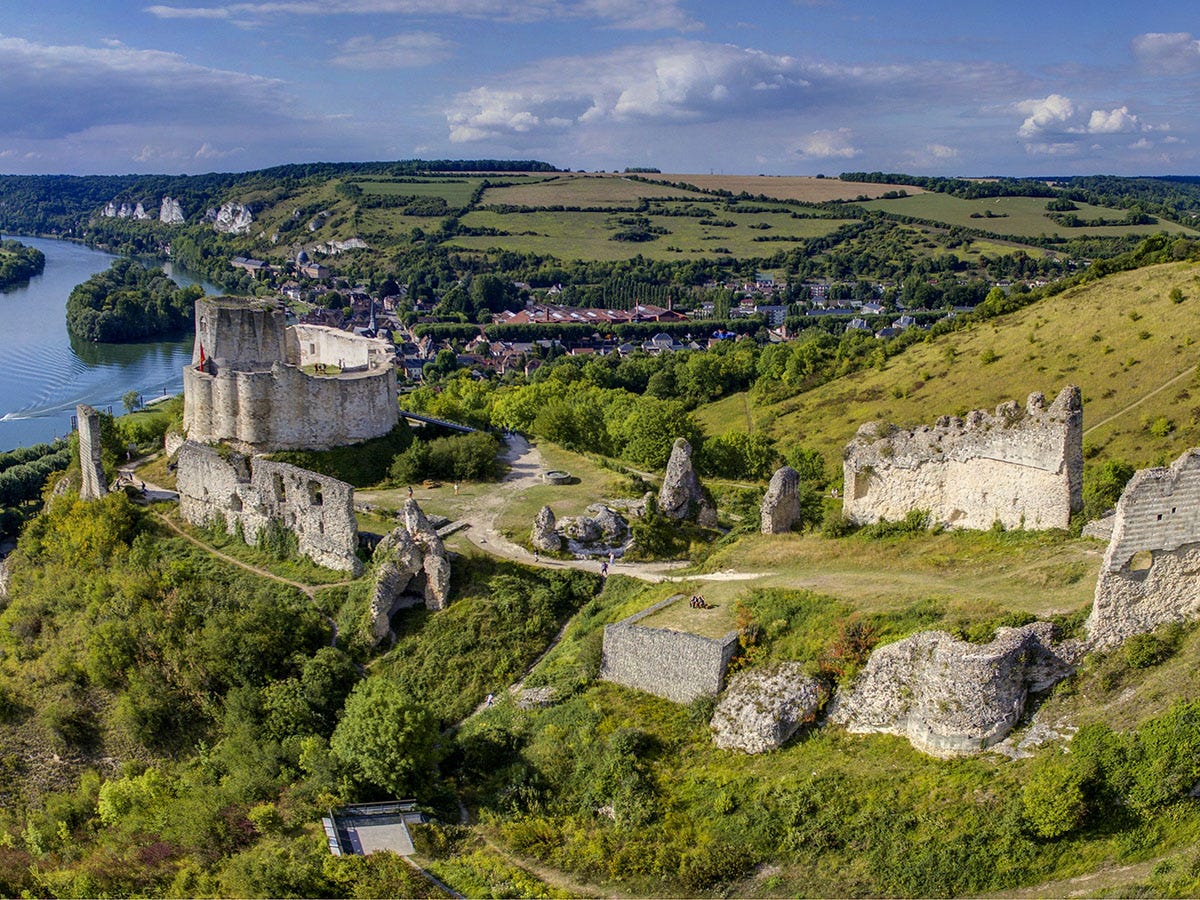
In the winter of 1203 and 1204, Château Gaillard was under siege. It was a difficult one: the castle had been built less than a decade before by Richard the Lionheart, at great speed and great expense. It featured cutting-edge military technology for the era: overlapping fields of enfilading fire, buttressed walls to discourage undermining,1 and some of the earliest European examples of machicolations. It sat on a stone outcrop above the Seine, guarding the doorway to eastern Normandy. Richard, who may have designed it himself, once boasted he could hold Château Gaillard even if its walls were made of butter. Unfortunately for every Angevin lord with land in England and the Continent, though, his brother John couldn’t manage it even with limestone.
King Philip II of France had invaded Normandy the year before, ostensibly in support of the Duke of Brittany’s claim to the English throne (though the war continued after his disappearance-and-probably-murder), and by September of 1203 he was outside Richard’s beloved castle. The people of the surrounding countryside and nearby towns very sensibly fled to avoid the besieging army, and the garrison commander, Roger de Lacy, admitted two thousand of them. Meanwhile, John’s forces prepared an ambitious two-pronged relief effort that would have been extremely cool if it had worked, but — due to mis-timed tides and poor coordination between the land and river elements — did not.2 Chastened, John withdrew across the Channel, leaving de Lacy a letter saying essentially “good luck bro,” and everyone settled in for a lengthy siege.
Sieges were the central fact of medieval warfare. We tend to think of the pitched battles,3 because they’re big and flashy and exciting and could change the course of a whole war in a few hours, which is exactly why commanders avoided them. Changing the course of a whole war in a few hours is rarely ideal. The entire nineteen years of the Anarchy, for example, featured only four or five real battles. Henry II, who built and defended a massive empire, fought none at all, and his son Richard I, who spent a quarter of a century in near-constant warfare, had between two and five depending on how strictly you define your terms. (The two inarguable ones are Jaffa and Arsuf, but even those were forced on him by circumstance.)
So if you prefer maneuver and ambush to battle, you’ll end up with a lot of sieges for the simple reason that castles are very, very hard to get into if the people inside don’t want you. This is the entire point of castles. But if you’re a commander you can’t very well leave an occupied castle at your rear, because the mounted warriors inside it can then ride out at their leisure to cut your supply lines, harry your foraging parties, ambush your columns on the road, and burn the land you depend on for your food and wealth. (The operational radius for “day trip” cavalry activity is about ten miles, but knights can threaten well beyond that if they’re not worried about getting back behind walls by nightfall; in 1174 rebels rode the 30+ miles from Leicester Castle to plunder Northampton.) Thus, the siege: you camp outside the walls, kill anyone who comes out, look for an opportunity to get inside, negotiate, and wait.
The balance between these activities varies by siege and commander. Of course you can just sit there until the defenders run out of food, but (1) it takes a long time and delays the rest of your campaign, (2) you run the risk of an enemy army showing up to chase you off,4 and (3) a siege camp is a fantastic breeding ground for disease. The most famous “camp fever,” typhus, didn’t come to Europe until the fifteenth or sixteenth century, but typhoid fever and all kinds of exciting dysentery-inducing bacteria were around much earlier. (Apparently we now think the Plague of Athens was typhoid fever! Friendly reminder to check in on what DNA sequencing has revealed about your favorite wars.) More effective, if you could manage it, was to take the castle by storm, whether by going over the walls or by breaching them and going through the gap. And even better than that was to pull something sneaky: bribing someone to open a gate, disguising yourselves as woodcutters or farmers come to supply the garrison, climbing the privy shaft, and whatever other secret plans and clever tricks you can think up.
Any kind of siege was exceptionally dangerous and expensive for both sides (during Henry III’s 1266 siege of Kenilworth, his army ate an entire whale5 on top of everything else), so a set of conventions naturally arose to avoid bloodshed. If everyone recognizes that the castle will fall without a relief force, why not just…surrender now and save everyone the trouble? A surrendering garrison was usually allowed to march away unharmed with its arms intact while the survivors of a defeated one were considered fair game for summary execution, so holding out against impossible odds was dangerous even if you survived the castle’s fall. On the other hand, if you’re a garrison commander whose boss thinks you surrendered too quickly, you could lose your own head. A common compromise was therefore to allow the garrison to send for help with a deadline: if by the end of seven days (or forty, or whatever else seemed numerologically pleasing) no army showed up to relieve the defenders, they would surrender peacefully. (If relief did appear, the besiegers usually left rather than giving battle.)
This didn’t happen at Château Gaillard. The king had made it very clear he wasn’t coming, but Roger de Lacy refused to surrender the castle “even if he had to be dragged out by his feet.”6 But de Lacy had a problem: the two thousand civilians he had admitted for protection when he thought relief was on the way. The castle was so well-designed it could be defended by a small garrison, and there were enough supplies to feed those couple hundred men for a year — but not the extras. Accordingly, in November de Lacy expelled five hundred of the oldest and weakest noncombatants from the castle. The French allowed them through the siege lines (though they were now refugees in winter whose towns and farms were occupied by an enemy army), and a few days later another group followed.
It was the logical move for de Lacy, and a humanitarian response from the French. But it didn’t survive contact with the king: as soon as Philip heard what his commanders had done, he forbade them from allowing any more noncombatants out. He wanted those “useless mouths” left in Château Gaillard, where they would eat up the garrison’s rations and shorten the siege without contributing anything to the defense.
Roger de Lacy put them out anyway.
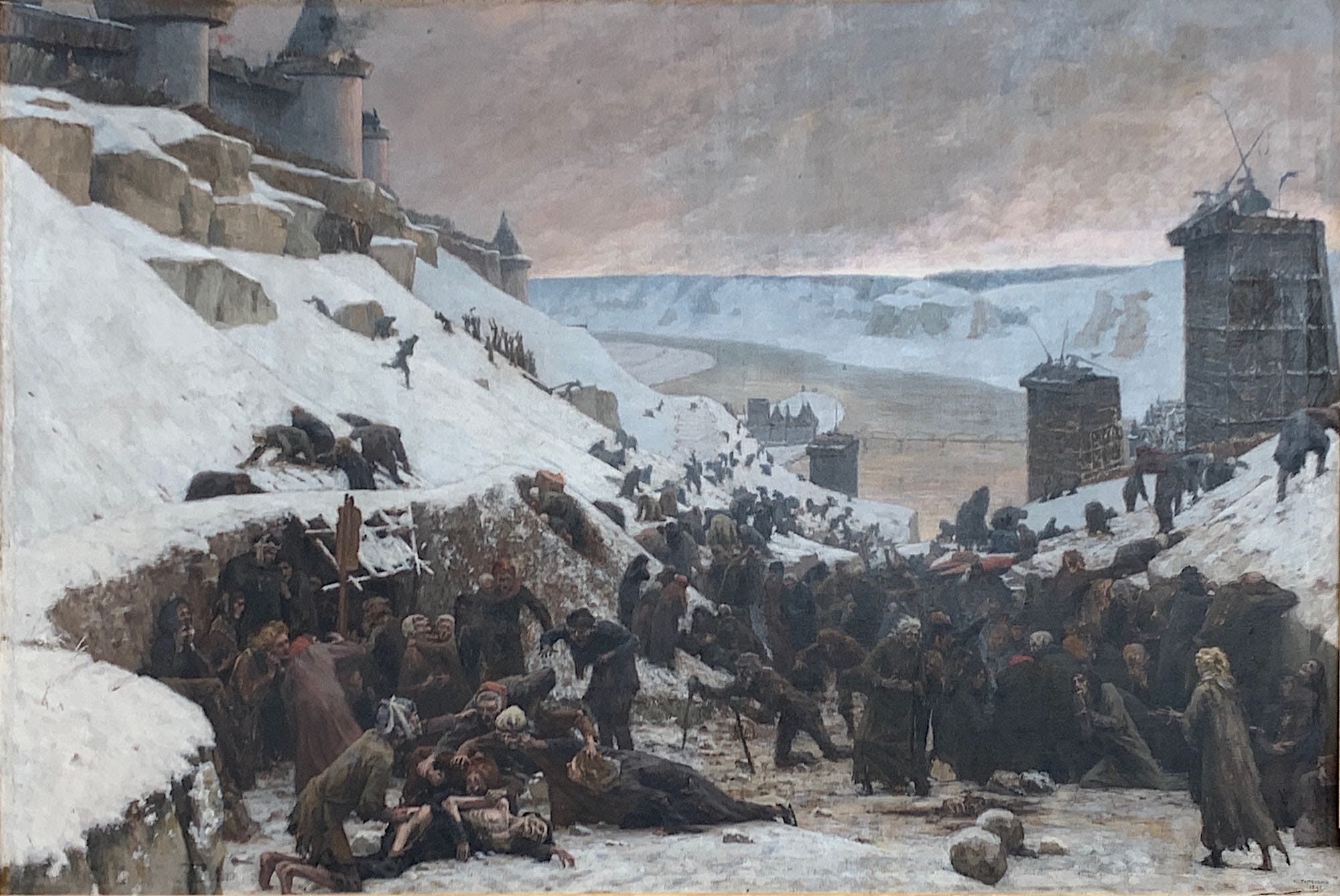
King Philip’s chaplain William the Breton, whose account of what followed is our main source for the siege of Château Gaillard, writes that the refugees expected to pass through the French camp like their friends and neighbors had done but were instead met with javelins and arrows. When they fled back to the castle, the garrison had barred the gates and drove them away with stones. They were left with no choice but to settle on the bare rock out of bowshot of either side. There they survived only on water from the nearby river, the flesh (and eventually also skins) of the dogs de Lacy had put out of the castle, and a passing hen that landed in their midst and was gulped down “with feathers, bones, and its droppings still warm.” Most horribly, a woman is reported to have given birth in the midst of this starving throng: her child, “red from its mother,” was torn apart and devoured, “passing in a moment from its mother’s belly into many bellies.”7
In February, four months after the original expulsion, King Philip arrived and generously allowed the starving survivors (fewer than half of the original number) into the French camp where they were finally fed. William writes that he himself saw one of them who “clung to a dog’s thigh-bone” and refused to set it down until he was sure there would be other food. (This, McGlynn notes, is a touch of realism “striking for [its] modern parallels”: two of the starving survivors of the Essex “were reluctant to surrender the bones on which they had been gnawing and relying for sustenance. The bones were those of other crewmen.”) Like many other historical victims of starvation, nearly half of them ate too much too quickly and died of it.
Château Gaillard is far from the only medieval example of “useless mouths” expelled to conserve supplies during a siege. In 1347, five hundred refugees starved between the walls of Calais and Edward III’s siege camp. During the 1418 siege of Rouen, the number was more than twelve thousand, and children born in the ditch outside the walls were hauled up in baskets to be baptized in the city then let down again to starve with their mothers. Strategically, the expulsions make sense — the besieged garrison wants to make their supplies last as long as possible, so sharing them with people who can’t join in the defense is a dead loss — but so does the besiegers’ refusal to let them through their lines. If you feed, or even just release, this particular batch of refugees, you’ll get another batch at this siege or the next and your campaign will lose momentum while your army gets sick, and your enemy appears to chase you off. On the other hand, if the people of Castle Next remember the starving civilians of Castle This One, maybe the commander of that garrison won’t have the guts to do it, or maybe the noncombatants will help your men sneak in and open the gates to save their own lives. And if not, at least watching people they were protecting a few days before suffer the same slow death from starvation that faces them will sap the garrison’s morale.
As for Château Gaillard, the castle fell in March. The surviving Englishmen were led off to an honorable captivity rather than executed, and most of them (including de Lacy) were eventually ransomed. By August, the French had conquered nearly all the English holdings on the Continent.

By Sword and Fire is more or less a compendium of military horror stories from the eighth to the fifteenth centuries: massacres of prisoners, sacked cities and slaughtered citizens, countrysides so ravaged and burned that the peasants starved. But it’s also an argument that these weren’t gratuitous atrocities perpetrated by sadists but effective strategic moves. The meta of medieval warfare so heavily favored defense8 that psychological and attritional warfare became extraordinarily effective. Beyond starving the expelled noncombatants, medieval sieges included such hits as “throw the severed heads of captured enemies back over the walls to their comrades,” “tie prisoners to the outside of your siege equipment so the defenders can’t attack them without attacking their comrades” and its counterpart “dangle captured attackers from your walls directly in front of the battering rams,” and my personal favorite, “blind the entire garrison except for one man, who gets to keep one eye so he can lead the rest of them to the next castle you’re planning to besiege.” The brutality meted out to those who held out to the bitter end — McGlynn gives extended attention to Jerusalem in 1099, Béziers in 1209, and Limoges in 1370 — was at least in part deterrence for future sieges. To coin a phrase, the cruelty was the point.
Nowhere is this more obvious than in the ravaging of the enemy countryside, which extended the terror of death from violence or starvation from the environs of the besieged castle to everyone. Here’s a twelfth century poem’s description9 of what happens when an army marches though enemy country:
They start to march. The scouts and the incendiaries lead; after them come the foragers who are to gather the spoils and carry them in the great baggage train. The tumult begins. The peasants, having just come out to the fields, turn back, uttering loud cries; the shepherds gather their flocks and drive them towards the neighboring woods in the hope of saving them. The incendiaries set the villages on fire, and the foragers visit and sack them; the distracted inhabitants are burnt or led apart with their hands tied to be held for ransom. Everywhere alarm bells ring, fear spreads from side to side and becomes general. On all sides one sees helmets shining, pennons floating, and horsemen covering the plain. Here hands are laid on money; there cattle, donkeys, and flocks are seized. The smoke spreads, the flames rise, the peasants and the shepherds in consternation flee in all directions. …
[Once the knights have passed] [i]n the cities, in the towns, and on the small farms, wind-mills no longer turn, chimneys no longer smoke, the cocks have ceased their crowing, and the dogs their barking. Grass grows in the houses and between the flag-stones of the churches, for the priests have abandoned the services of God, and the crucifixes lie broken on the ground. The pilgrim might go six days without finding any one to give him a loaf of bread or a drop of wine. Freemen have no more business with their neighbors; briars and thorns grow where villages stood of old.
McGlynn describes four examples of historical ravaging at length, and spends a lot of that time getting into the historiographical arguments over which chroniclers we can trust how far when we try to determine how bad it really was. (This is relevant for the siege of Château Gaillard too, of course; William the Breton had an obvious pro-Philip agenda, which — perhaps counterintuitively — incentivizes exaggerating the suffering of the bouches inutiles, since he presents feeding them as the obvious duty of their compatriots and the eventual generosity from their enemy the French king as entirely supererogatory.)10 When William of Malmesbury wrote in 1125 that William the Conqueror’s punitive expedition in Yorkshire half a century earlier laid such waste to the county that “the ground, for more than sixty miles around, [was left] totally uncultivated and barren, remaining bare even to this present,” should we take him literally? When chroniclers record strikingly similar atrocities during Scottish invasions of England that took place in 1070, 1138, and 1296, is that because they had become propaganda shorthand for “barbaric violence on the Celtic fringes” or because impaling infants, mutilating women, and burning schoolboys were really frequent occurrences?
But even if you don’t find the fight over the details interesting, it’s very clear that deliberate killing, burning, and looting of non-combatants happened all the time, because it worked. In a heavily agricultural economy, a (very literal!) scorched-earth policy destroys your enemy’s ability to field an army: the people who farm his land are either fled, dead, or starving to death because you burned their crops, so he has no one left to march against you and no way to pay his knights. (Also, now you have whatever you were able to snag before you destroyed everything else, which you can use to feed and pay your troops.) This is useful as a way of preventing him from fielding a future army, as punishment, and as leverage; even if you’re not in a position to comprehensively defeat the enemy — if, say, your army is mostly made up of lightly-armored, poorly-trained Scottish levies and 100% going to get spanked if you actually meet the English in the field — you can still do enough damage that it’s easier for your enemy to pay you to go away grant valuable concessions than to chase you off or let you keep raiding. (This worked repeatedly for the Scots, who did very well out of their twelfth century invasions despite losing all the major battles.)
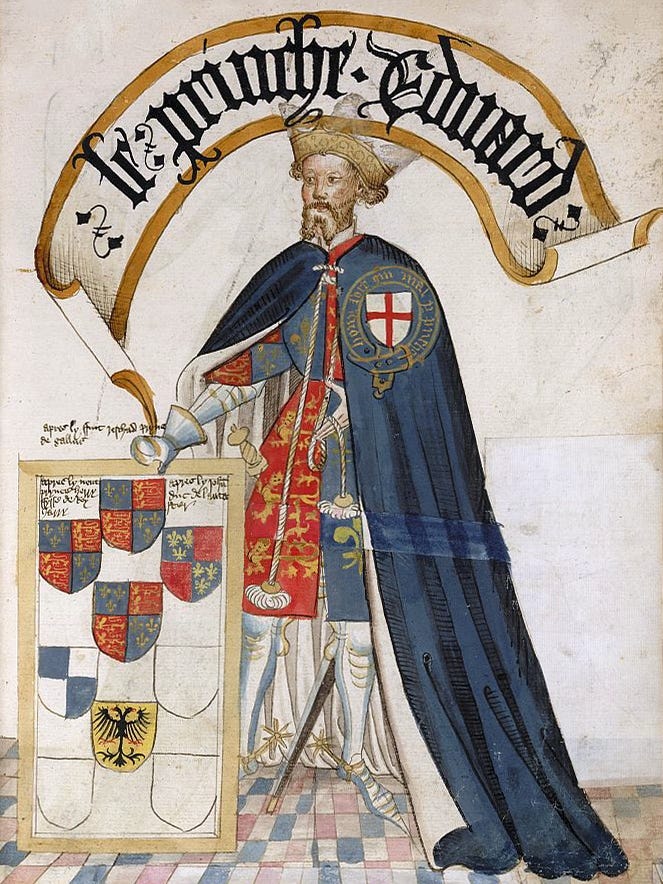
The most famous and best-documented examples of ravaging as intentional military strategy come from Edward, the Black Prince (eldest son of Edward III and father of Richard II), in the early phase of the Hundred Years’ War. There were several, but McGlynn gives extended attention to the autumn of 1355, when the prince marched a seven-thousand man army from Bordeaux on the Atlantic to Narbonne on the Mediterranean and back. Medieval military historians are still arguing about the strategy behind it (if he was trying to provoke the French into giving battle, he failed), but whatever his goal, the prince’s army wrought devastation across a broad swath of countryside and pillaged more than five hundred villages, towns, and castles, took enough booty to fill a thousand carts, and lost very few men in the process. French chroniclers described it in terms virtually identical to the earlier poet’s: “The eye of man was saddened by the looks of the nettles and thistles springing up on every side. Instead of houses and churches there was the lamentable spectacle of scattered, smoking ruins to which they had been reduced by devouring flames.”
The military utility is obvious: the Black Prince fed his army and rewarded them with the riches of the plundered at the same time as he weakened his enemy’s tax base. But ravaging the countryside was also a way of showing the French that their king was too weak to protect them (so wouldn’t they like to be ruled by the King of England instead). It’s almost exactly the calculus behind Sherman’s March to the Sea.
Okay, fine, but we all already knew the Middle Ages were really bloody and horrible and everything spent a thousand years being covered in mud. There’s a reason Marsellus Wallace didn’t threaten to get Long Nineteenth Century on anyone’s ass! And yes, McGlynn makes a convincing case that war crimes (or things that would have been war crimes if international humanitarian law had been clearly articulated at the time, which pace the Peace of God movement it wasn’t) made strategic sense for medieval commanders — as indeed they do for modern ones, which is why we’ve bothered making up international humanitarian law to stop them. (His conclusion spends a lot of time on ancient and contemporary parallels to his medieval atrocities, from Caesar’s siege of Alesia to the treatment of prisoners in the Pacific during the Second World War, to establish that the Middle Ages weren’t uniquely awful.) The specifics may be unexpected, but the general what isn’t really a surprise. The thing that struck me is the who, and that requires a little explanation.

When I said “the Black Prince” above, that probably didn’t mean much. You may in fact have thought of Will Smith. So you’re just going to have to take my word for it that once upon a time it was like saying “Nikola Tesla” or “Alexander Hamilton” — not a top tier figure in the cultural imagination, but certainly recognizable as a vibe-y archetype. “Tesla” is shorthand for a visionary scientific underdog. “Hamilton” means…well, actually I’m not sure, I only listened to the George III songs, but I don’t think it’s “in favor of a strong executive and a national bank.” And until about a hundred years ago, “the Black Prince” was shorthand for chivalry and knightly virtue.
Yes, the same guy who bloodily pillaged southern France. But there’s real basis for his reputation: his father, Edward III, knighted the sixteen-year-old prince on the eve of the Battle of Crécy, gave him command of the vanguard, and declined to send reinforcements even when his men were hard-pressed, saying instead “Let the boy win his spurs.” After the English victory, the prince was so struck by the valor of the blind King John of Bohemia, who had ordered his knights to lead his horse into the thickest of the fighting and been killed there, that he adopted his motto and crest of ostrich feathers. (They’re still a symbol of the Prince of Wales.) A decade later the Black Prince had sole command at the Battle of Poitiers, where despite being outnumbered almost three-to-one he defeated the French army and captured the king and his son. Afterwards, when the king was his prisoner, he served him at a banquet “as humbly as he could” and refused to sit with him out of respect for royalty. Jean Froissart, the best-known chronicler of the Hundred Years’ War, called him the “flower of English chivalry.” And because the prince predeceased his father and never actually ruled (and because his famously awful son led to a century of unstable succession, civil war, and eventually the Tudors), his reputation as a perfect knight was always accompanied by a wistfulness, a sense of missed opportunity. It’s sort of the way people think about RFK père. Or Barry Goldwater, or the second Trump administration c. January 21, 2025 depending on your politics.
The Black Prince’s reputation peaked in the Victorian/Edwardian eras, helped along by his appearance in Arthur Conan Doyle’s historical novel The White Company (which Doyle himself thought was his best book, though he also believed in fairies so grain of salt there). Popular children’s histories made much of him (here’s one example), and he featured heavily in the kind of “boys’ own” adventure stories that the Flashman novels satirize. When Robert E. Howard reached for synecdoche for his own heritage in the 1930s, he listed the Black Prince alongside Paul Revere. Like most Victorian heroes (who now remembers the gallant Gordon at Khartoum?) he’s since declined in popularity; uncomplicated admiration for killing lots and lots of people inexplicably went out of style somewhere around 1917. The few medieval warriors who still have any kind of grip on the popular imagination were preserved by fiction — Richard the Lionheart’s continued resonance is a little bit Ivanhoe and mostly Robin Hood, and Henry V is almost entirely Shakespeare (particularly via Branagh)11 — while the Black Prince has, uh, A Knight’s Tale.
And then, of course, there are the actual historical facts. I’ve already mentioned the Black Prince’s ravaging campaigns, but even more infamous his brutal sack of the city of Limoges. In the wake of the Battle of Poitiers, the prince had imposed heavy taxes on his principality of Aquitaine to fund his wars in Spain, and in 1370 many of the lords joined a French-backed revolt against his rule. The richest of the rebellious settlements was Limoges, whose bishop was a personal friend and had stood godfather to his eldest son, so he took it personally and, according to Froissart, “swore on the soul of his father – an oath which he never broke – that he would attend to no other business until he had won the city back and made the traitors pay dearly for their disloyalty.” After a brief siege, his men “burst into the city, followed by pillagers on foot, all in a mood to wreak havoc and do murder, killing indiscriminately, for those were their orders. There were pitiful scenes. Men, women and children flung themselves on their knees before the Prince, crying: ‘Have mercy on us, gentle sir!’ But he was so inflamed with anger that he would not listen. Neither man nor woman was heeded, but all who could be found were put to the sword, including many who were in no way to blame…. Many more than 3,000 persons, men, women and children, were dragged out to have their throats cut.” (More recent scholarship suggests it was actually more like three hundred, but even so.) The bishop was spared only by the intervention of the prince’s brother, and the city was so thoroughly burned that it took more than a century to rebuild.
So that’s the flower of chivalry, huh?
It’s no wonder, then, that McGlynn and the eminent medievalists he quotes conclude that the code of chivalry — insofar as it existed at all as a military reality rather than a literary conceit — was just a class-protection scheme for the mounted elite.12 The late Cornell professor Paul Hyams described it as “a declaration of knightly labour union rules,” a reassurance that in battle “you and your genteel peers were not expected to go so far as killing each other, that you merely competed for the twin prizes of knightly valour and earthly swag.” Captured knights got captured, feasted, and released for ransom; footsoldiers got stabbed to death in the mud; civilians got burned out, starved, and worse. Who cares that the prince won stunning victories and treated his prisoner with all the deference due an anointed sovereign when he also did terrible things? The Victorians cleaned off the mud and left a generation of schoolboys nothing but shining armor and pennants snapping in the breeze; historical revisionism brought back the screams of the dying but stole the moments where the music swells. If the brutality is real, as it obviously was, then the glory must just be PR.
And yet the pre-modern imagination managed to hold both at once, and in the same people. Froissart gives us “the flower of English chivalry” extending elaborate courtesy to a beaten enemy and still responsible for “pitiful scenes” of massacre. Shakespeare’s Henry V gives us the famous “band of brothers” speech as well as the offstage murder of prisoners and the threat of a bloody sack at Harfleur if the French don’t surrender to his siege:
If I begin the batt’ry once again,
I will not leave the half-achieved Harfleur
Till in her ashes she lie burièd.
The gates of mercy shall be all shut up,
And the fleshed soldier, rough and hard of heart,
In liberty of bloody hand, shall range
With conscience wide as hell, mowing like grass
Your fresh fair virgins and your flow’ring infants.
What is it then to me if impious war,
Arrayed in flames like to the prince of fiends,
Do with his smirched complexion all fell feats
Enlinked to waste and desolation?
What is ’t to me, when you yourselves are cause,
If your pure maidens fall into the hand
Of hot and forcing violation?
And at the siege of Château Gaillard, William the Breton saw no contradiction in first reporting his royal master’s order to leave the bouches inutiles starving on the rocks and later praising his magnanimity in feeding those who survived.
Perhaps this shouldn’t be surprising; after all, I just read 300+ pages about how strategic atrocity was an essential element of medieval warfare, so obviously anyone notable for military prowess will be a problematic fave. But we are, culturally, extremely bad at dealing with people who are truly admirable in some regard but have also done terrible things. We don’t want to hold this tension without resolving it: either the bad stuff is played down so we can cheer for the good guys without complication, or the glory is revealed as a lie that hides the grim darkness beneath. And nowhere is this more obvious to me than in the contemporary successors to chansons de geste, Froissart, and Shakespeare, by which I mean, of course, fantasy fiction.
George R. R. Martin famously complained that “Lord of the Rings had a very medieval philosophy: that if the king was a good man, the land would prosper. We look at real history and it’s not that simple. Tolkien can say that Aragorn became king and reigned for a hundred years, and he was wise and good. But Tolkien doesn’t ask the question: What was Aragorn’s tax policy? … Real-life kings had real-life problems to deal with. Just being a good guy was not the answer. You had to make hard, hard decisions.” And he’s entirely correct as far as he goes — The Lord of the Rings is not a work of literary realism, nor is it trying to be. I would love to read the fantasy novel about a king who’s wise and good but still has to deal with real-life problems in a world like ours, a vale of tears touched with glory. Someone should write that novel! George Martin didn’t.
His novels (and grimdark fantasy more broadly) fall short precisely where they embrace McGlynn et al.’s revisionism: the chivalry and the brutality never coincide. Dark and gritty stories may be truer to life insofar as they accurately represent one aspect of the history they’re modeled on — Tolkien doesn’t shy away from the horror of war, but his protagonists are its victims rather than its perpetrators — but they ignore another. The narrative punishes anyone brave or noble or magnificent who tries to avoid those “hard, hard” decisions, giving us instead jaded antiheroes battling sadistic monsters or small, grubby villains. That can be fun to read, but it’s strange that the genre of fantasy, so self-consciously indebted to real history, never gives us that most medieval of figures: the great man who is also a great sinner, the butcher of Limoges and the flower of chivalry.
Or perhaps it’s not strange at all, because a figure out of medieval culture is hard to comprehend without a mindset out of medieval culture. We moderns are in thrall to the idea that there’s some deep-down core identity that’s “really” you, to which you can be true or false, and which it’s properly your life’s work to discover (probably by means of therapy). The antihero is an obvious outgrowth of this view: sure, he may be like a ruthless misfit who plays by his own rules, but really he’s a good guy. (Or, on the flip side, his one unforgivable crime reveals the depths of wickedness that were always already there; he was really bad all along.) The older, more porous view of the self has no “really” to it — the self is not preëxisting but created, by external forces, actions of the will, sin and repentance, which leaves room for unresolved tensions. David was held up as the archetypical medieval king, and he was both an adulterous murderer and a man after God’s own heart…neither of which erased the other. Grimdark’s deconstruction of heroic fantasy tropes, like McGlynn’s revisionism of the Victorian historiography, assumes that the world is really one way or the other. If we establish the truth of the black parts (and here’s a three-hundred-page book that does just that), then the result must be, at best, shades of grey. The more honest view, if you want to look at real history, is that some parts are very black and some are very white.
Literally — digging mines under the wall. I can never decide if reading history or raising children is the best way to see dead metaphors come alive, but at least siege warfare eight hundred years ago isn’t as gross as someone biting off more banana than they can chew.
Consensus among the historians who turned up in my extremely lackadaisical Googling seems to be that the synchronization the plan required was far too clever for the available military technology, though they disagree about whether this speaks poorly of John as a strategist or of his commanders. It’s also worth noting that Substack favorite William Marshal led the land assault, which went off properly.
Note for girls and other readers I am cruelly stereotyping: a pitched or set-piece battle is one to which both armies intentionally choose to commit. The alternative is an ambush or chance encounter where one side doesn’t have time to deploy properly. Most battles with names you recognize qualify as a pitched battles. (Despite the best efforts of my middle-school history teacher and The Killer Angels, I have only this month learned to read those diagrams with all the little boxes that show you troop movements.)
The castle garrison could also come out of the castle and attack you to break the siege, but this was dangerous. While still Duke of Aquitaine, Richard I took the supposedly-impregnable castle of Taillebourg by chasing the retreating sortie party back through their own gates.
This is even more of a flex than it sounds like, because whales were “the king’s fish” and any beached whale anywhere in England was officially the king’s property.
Fun story: I thought this was a cool enough boast I wanted to include it, but there was no note for me to double-check that it was being accurately quoted. Google gave me only people quoting McGlynn. McGlynn’s source, the Anonymous of Béthune, is not digitized in English, but Internet Archive has a scan of an 1840 copy of the Old French, which I can puzzle through a sentence at a time but certainly not fast enough to find the siege of Château Gaillard and check on de Lacy’s feet. Luckily, Claude found it for me on page 103. (Anonymous of Béthune actually says “he would only surrender the castle if he were dragged out by the foot,” which is why my ctrl+f for piés on the terrible OCR didn’t find it.) See how much AI is already enhancing my efficiency as a book reviewer? I used to spend hours going down these random rabbit holes. Now I can do it in minutes. You’re welcome.
The translations in this paragraph are mine. They’re from William the Breton’s Latin epic poem, the Philippide, which is an extremely funny document full of excellent Homeric similes, and also absolutely horrific.
Apparently the technical term for this is “offense-defense balance” but it’s more fun to say that machine guns nerfed the infantry assault. John wrote about it here.
Okay, it’s actually Achille Luchaire (1912) quoting the Chansons des Lorrains (12th c.) describing the 8th century, but, as with medieval artwork, medieval historical fiction wasn’t going for verisimilitude. Also, the prequel to this poem has Charles Martel (d. 741) fighting the Vandals (fl. c. 400), which is a great Guns of the South moment avant la lettre.
This is totally contrary to my intuitions — the French seem obviously more blameworthy than the English for the deaths of the bouches inutiles — but this appears to be chronological provincialism on my part. The Lieber Code of 1863 says that “[w]hen a commander of a besieged place expels the noncombatants, in order to lessen the number of those who consume his stock of provisions, it is lawful, though an extreme measure, to drive them back, so as to hasten on the surrender.” As recently as 1948 the judges at Nuremberg acquitted German commanders of war crimes charges for firing on civilians fleeing Leningrad, though they added, “We might wish the law were otherwise, but we must administer it as we find it.” (The law became otherwise in 1977 with the Additional Protocols to the Geneva Convention.)
I kept trying and failing to think of a way to work John Keegan’s The Face of Battle into this book review, so here, Agincourt obliquely mentioned, good enough. It’s an excellent book. Read it.
“Just” is doing a lot of work here. Yes, serving a captured king at table is a kind of class solidarity. That’s exactly why it’s a virtuous gesture. If you disagree with me imagine it’s the working class instead.
Thank you for articulating exactly why I love Lord of the Rings and couldn't get into Game of Thrones/A Song of Ice and Fire at All. Apart from the fact that I think the writing is awful and the storytelling convoluted, I just couldn't stomach the unrelenting cynicism of it ("jaded antiheroes battling sadistic monsters or small, grubby villains"). The way we're unable to hold both the grim and the glorious when it comes to medieval figures reminds me of how the Odyssey movie tried to impose a kind of modern, Christian ethos on top of an Ancient Greek story, missing the duality in Homer that killing lots of people on the battlefield is presented as BOTH glorious and atrocious. Achilles, Odysseus, etc. are heroes to be admired and emulated, but they're also presented as committing horrific acts of violence.
"His novels (and grimdark fantasy more broadly) fall short precisely where they embrace McGlynn et al.’s revisionism: the chivalry and the brutality never coincide. Dark and gritty stories may be truer to life insofar as they accurately represent one aspect of the history they’re modeled on — Tolkien doesn’t shy away from the horror of war, but his protagonists are its victims rather than its perpetrators — but they ignore another. The narrative punishes anyone brave or noble or magnificent who tries to avoid those “hard, hard” decisions, giving us instead jaded antiheroes battling sadistic monsters or small, grubby villains. That can be fun to read, but it’s strange that the genre of fantasy, so self-consciously indebted to real history, never gives us that most medieval of figures: the great man who is also a great sinner, the butcher of Limoges and the flower of chivalry."
...Jon Snow? (You can of course argue that he is eventually punished by the narrative, but as you mentioned, so was Edward the Black Prince, who died before he could rule!)