

We’ve already established that I usually don’t read the comments on these posts, because I am a weak and fallible human and thus seek to avoid “engagement” at all costs. But some of you email me, and sometimes your emails contain book recommendations, and sometimes I end up reading those. No, I don’t mean you, the roughly 700 publishers’ agents1 who have started spamming me ever since this substack got put on some list somewhere. Your recommendations I will never, ever read so long as I live. But the rest of you are great.
The Dispossessed, Ursula Le Guin (Harper & Row, 1974).
The purpose of literary science fiction is the study of human nature under extreme conditions. It’s like how when we want to see what matter is really made of, we stick it into a particle accelerator or fling it into a black hole. How else are you going to discover quantum gravity? Well one of the main themes of this substack is that human beings are as mysterious and protean as any subatomic particle, and the substances we form when we band together can be even weirder. History is replete with examples of individuals and groups behaving in interesting ways under varying pressures, and if you put them all together and deliberately blur your eyes a little bit a picture emerges. You might get a sense of this strange being “a little lower than the angels” yet possessed of a seemingly infinite capacity for cruelty and compassion, inquisitiveness and self-delusion, heartbreak and bliss. You could spend a lifetime doing this and still not be content with the answers. Ahh, what a piece of work is man, indeed.
Modern people are sometimes shocked when literature is grouped with the human sciences, I know for a long time I was. The assertion that this was because it spoke to “the human condition” only increased my perplexity. How could you study something real by making up imaginary stories? But if you get over yourself and think about it for a few minutes it makes total sense. Evolution and our upbringing have endowed us with an exquisitely sensitive capacity for modeling and simulating other human beings, but they have not given us a closed form theory of human activity. But the existence of the former can help us to bootstrap the latter by giving us a way to generate synthetic training data, including stuff that is out of distribution for our daily lives. The existence of this faculty for simulation is what enables us to write stories that ring true, and also what enables us to tell good stories from bad ones.
This is very important for we students of human nature, because history doesn’t contain quite enough material to pin our slippery subject down conclusively. But human beings and human societies are also notoriously difficult to run controlled experiments on (and for some reason IRBs are weirdly resistant when you try). So, like any good scientist, we fall back on gedankenexperiment, and the mark of real literature is the way it vacillates between making an assertion about human nature via an imagined situation, and being a piece of art with engaging plot, characters, and so on. Of course in the greatest literature, these two axes are not incidental to one another, but seamlessly interweave so that the one could not exist without the other. That this should be possible is also a bit miraculous, and reflects the fact that the macrocosm is also a kind of story, and that our great Author has a flair for irony, cliffhangers, allegory, sweeping character arcs, allusive reference, and all the other stock in trade of the novelist who wittingly or not acts in imitation of Him.
Anyway, speculative fiction is part of this noble lineage, and a very important part because it asks and answers questions about what human beings do in truly extreme circumstances. The gritty cyberpunk noir of a William Gibson and the sparkling post-scarcity vistas of an Iain Banks are both just scientific instruments aimed at probing this question. The trashiest space opera and the loftiest works of Gene Wolf are both one sort of answer: “nothing much changes,” whereas both Stephen Baxter and Kim Stanley Robinson are telling you, albeit in very different ways, that you have no idea just how much can change. The only scifi author I can think of who doesn’t really fit this schema is Greg Egan, but that’s because he’s too autistic to model human beings, and so the “characters” in his stories are the laws of physics themselves, and as soon as we make that mental switcheroo he once again fits neatly into this tradition.
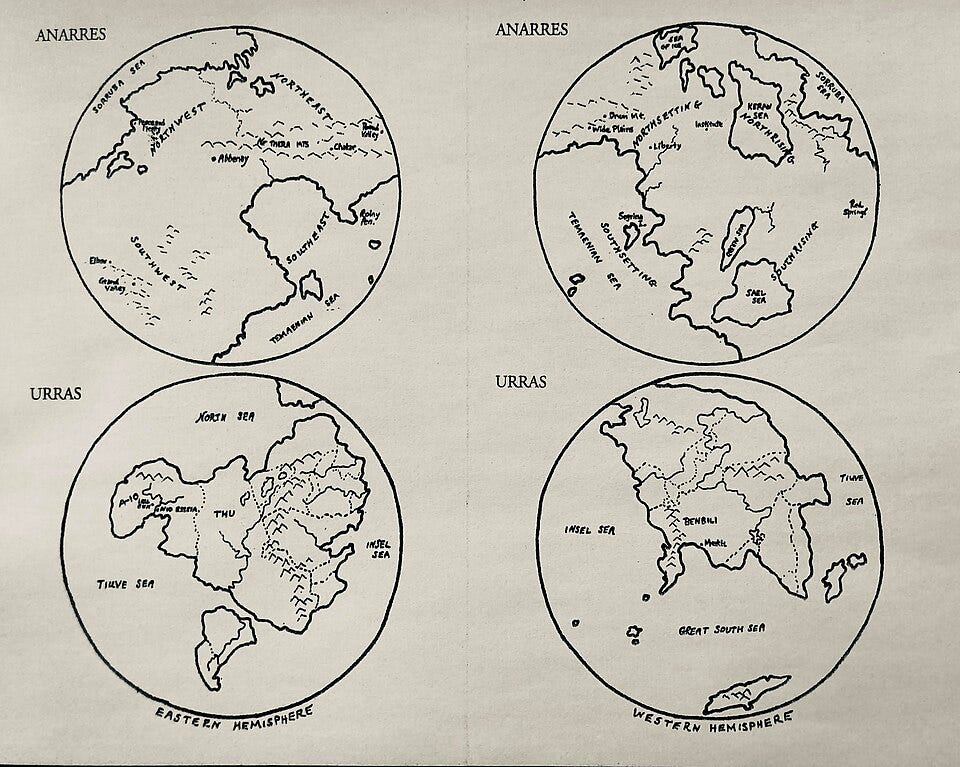
Few authors have done this as brilliantly, or with as much self-awareness, as Ursula Le Guin. One of her two main fictional universes, the “Hain” cycle, features a setting in which the precursors of humanity deliberately seeded a vast number of planets with their descendants, while performing genetic or social experiments on each one. This turns each of the many novels and short stories set in this world into a self-contained exploration of what individuals and societies might do if some important biological or ecological or social law of Earth’s history were modified.2 The Dispossessed, set in the Tau Ceti system, is one of the most subtle examples of her style. Here, people do not have any obvious biological differences from you and me,3 but live on twin planets Urras and Annares, each a moon of the other.
Urras is a familiar place, funny names and costumes notwithstanding. It features a temperate climate, reasonable biodiversity, and a panoply of warring nations that feature superficial ideological differences (some are capitalist and some communist), but underneath it every one of them is hierarchical, authoritarian, and oligarchic. It’s turbo-Earth, basically. So the main narrative device is none too subtle: Le Guin has a point of view character from a very different place come and react to it with horror (one of the oldest tropes around). That very different place is Annares, a barren and inhospitable world populated entirely by communalist anarchists.4 It was originally settled by a utopian social movement from Urras, and despite (or perhaps because of) the harsh environment has managed to survive and flourish and grow more complex while maintaining its ideals.
It would have been very easy for Le Guin, a die-hard leftist, to turn this into a pat morality tale (hierarchy: bad, anarcho-communism: good), but she’s too great an author to fall into that trap. Yes, Annares features all the hobbyhorses of 1970s scifi, including free love and gender equality and other pleasant fictions, but Le Guin takes pains to spotlight the bits of it that we might not find as pleasant. Subtly at first, then mercilessly, she forces you to reckon with the fact that the entire planet is one giant longhouse. Its supposedly free inhabitants are in fact prisoners of conformism and social pressure, their “voluntary” choices are every bit as determined by the desires of others as those of the free marketeers on Urras. And below that revelation comes another darker one, a festering core of hypocrisy that threatens to unmake everything these pioneers have built.
The tricky thing about fiction as a means of probing human nature is that it exhibits “reflexivity.” A great novel can shed light on how people behave, but it can also affect it. How many of the disastrous social experiments of the 20th century were inspired by literature, and how many of the writers of that era wrote to justify their disordered beliefs about human organization? The great thing about this book is that it ultimately resists being used in this way, but insistently returns to being a story about individuals, their loves, sufferings, and loyalties. What distinguishes the heroic characters on both planets is a simple faithfulness and a willingness to enter into each others’ pain, an act which only makes sense if we live in a very particular kind of story.
Ka: Stories of the Minds and Gods of India, Roberto Calasso (Knopf Doubleday, 1999).
Obviously I started reading it for the horse sacrifice. If you’re not familiar with the ritual of the Ashvamedha here is Wikipedia’s relatively tame description:
The horse to be sacrificed must be a white stallion with black spots. The preparations included the construction of a special “sacrificial house” and a fire altar. Before the horse began its travels, at a moment chosen by astrologers, there was a ceremony and small sacrifice in the house, after which the king had to spend the night with the queen, but avoiding sex.
The next day the horse was consecrated with more rituals, tethered to a post, and addressed as a god. It was sprinkled with water, and the Adhvaryu, the priest and the sacrificer whispered mantras into its ear. A “four-eyed” black dog was killed with a club made of Sidhraka wood, then passed under the horse, and dragged to the river from which the water sprinkled on the horse had come and set to flow south. The horse was then set loose towards the north-east, to roam around wherever it chose, for the period of one year, or half a year, according to some commentators. The horse was associated with the Sun, and its yearly course. If the horse wandered into neighbouring provinces hostile to the sacrificer, they were to be subjugated. The wandering horse was attended by a herd of a hundred geldings, and one or four hundred young kshatriya men, sons of princes or high court officials, charged with guarding the horse from all dangers and inconvenience, but never impeding or driving it.
The escort had to prevent the stallion from mating with any mares during its journey, and if he did, an oblation of milk was performed to Vāyu. If the horse became ill with injury, an oblation of pap to Pūṣan. If he became ill without injury, then an oblation of cake to Agni Vaiśvānara. If he was afflicted with eye disease, an oblation to Sūrya. If the horse drowned, an oblation was performed to Varuṇa. If the horse was lost, an oblation of cake, potsherd, and three other dishes to the deities of heaven and earth, along with an oblation of milk to Vāyu and pap to Sūrya. If the horse died, then another was selected and consecrated to replace it. During the absence of the horse, an uninterrupted series of ceremonies was performed in the sacrificer’s home. Every day, three Sāvitreṣṭi rites and one evening Dhṛtihoma would be conducted by the priests. In the evening after the Dhṛtihoma, two Brahmin and two Kshatriya bards and lutists would praise the patron king’s generosity, who gave 4,000 cows and 400 gold coins to the priests on the first day of the sacrifice. Then a session of pariplavākhyāna took place. The pariplāvana was the cyclical recitation of tales, in which one out of ten topics would be discussed each night, with 36 cycles of the ten topics. The tales were witnessed by an audience of onlookers called the upadrāṣṭṛ, who attended in their free time.
After the return of the horse, more ceremonies were performed for a month before the main sacrifice. Twelve days of dīkṣā rites took place, and then twelve days of upasad. The dīkṣā rite was a preparatory consecration rite performed before sacrifices. It consisted of a preliminary oblation, and then the king would bathe, dress in black antelope skin, and sit on another skin in a hut in front of a fire, fasting in silence with a covered head and sleeping on the ground. The upasad was a multiday ceremony that precedes Soma sacrifices. It consisted of the acquisition and welcoming of Soma and the construction of various structures needed for the sacrifice, along with the sacrifice of a goat.
On the twenty-fifth day, the agniṣṭoma was performed. The agniṣṭoma was the main part of the Soma sacrifice. In the morning pressing, the soma was pressed out and offered along with “rice cakes, parched barley, flour in sour milk, parched rice, and a hot mixture of milk and sour milk”. During the pressings and oblations, five musical chants were sung and five recitations were chanted. The priests then partook in the drinking of the soma and the twelve oblations to the seasons, and the sacrifice of a goat to Agni. The midday pressing was similar and dedicated to Indra, and dakshina was also distributed on that day to the priests consisting of a varying multitude of cows. At the evening pressing only two musical chants were sung and two recitations chanted. Then proceeded the conclusory libations to the “yoking of the bay horses” and the sun, followed by the Avabhṛtha. The Avabhṛtha was the “unpurificatory” bathing of the sacrificer at the end of the sacrifice. After an antelope skin was put in the water body, the king, his wife, and the priests ritually bathe. Afterwards a sterile cow or eleven other animals are sacrificed. Throughout the entire night, the annahoma was performed at the Uttaravedi (the northern altar). It consists of an oblation of clarified butter, fried rice, fried barley, and fried grain.
On the twenty-sixth day, the king was ritually purified, and the horse was yoked to a gilded chariot, together with three other horses, and Rigveda (RV) 1.6.1,2 (YajurVeda (YV) VSM 23.5,6) was recited. The horse was then driven into water and bathed. After this, it was anointed with ghee by the chief queen and two other royal consorts. The chief queen (mahiṣī) anointed the fore-quarters, the favorite wife (vāvātā) the middle, and the discarded wife (parvṛktī) the hindquarters. They also embellished the horse’s head, neck, and tail with golden ornaments and 101 or 109 pearls. After this, the horse, a hornless black-necked he-goat, and a Gomṛga were bound to sacrificial stakes near the fire, and seventeen other animals were attached with ropes to the horse. The he-goat dedicated to Agni was attached to the horse’s chest. A ewe dedicated to Sarasvatī was attached under the horse’s mouth. Two black-bellied he-goats dedicated to the Aśvins were tied to the horse’s front legs. A dark grey he-goat dedicated to Soma-Pūṣan was attached underneath the horse. On the two sides of the horse were attached a black goat to Sūrya and a white goat to Yama. Two goats with shaggy thighs were dedicated to Tvaṣṭar. A white goat dedicated to Vāyu was attached to the tail. A cow about to give birth was dedicated to Indra, and a dwarfish cow was dedicated to Viṣṇu. A great number of animals, both tame and wild, were tied to other stakes, according to one commentator, 609 in total. The sacrificer offered the horse the remains of the night’s oblation of grain. The horse was then suffocated to death. The chief queen ritually called on the king’s fellow wives for pity. The queens walked around the dead horse reciting mantras and obscene dialogue with the priests. The chief queen then had to spend the night beside the dead horse in a position mimicking sexual intercourse and was covered with a blanket.
On the next morning, the priests raised the queen from the place. One priest cut the horse along the “knife-paths” while other priests started reciting the verses of Vedas, seeking healing and regeneration for the horse. The horse’s epiploon along with soma are offered in an oblation, and the priests dismember the horse and other animal victims with an oblation of their blood. On the third day an Atirātra was performed. The Atirātra was a Soma sacrifice in which there was a nocturnal session where soma was drunk. Afterwards an Avabhṛtha takes place. However, in the Ashvamedha sinners and criminals also take part in the purificatory bathing. Afterwards twenty-one sterile cows are sacrificed, and the dakshina was distributed to the priests. The main dakshina forms either the four wives of the king or their four hundred attendants.
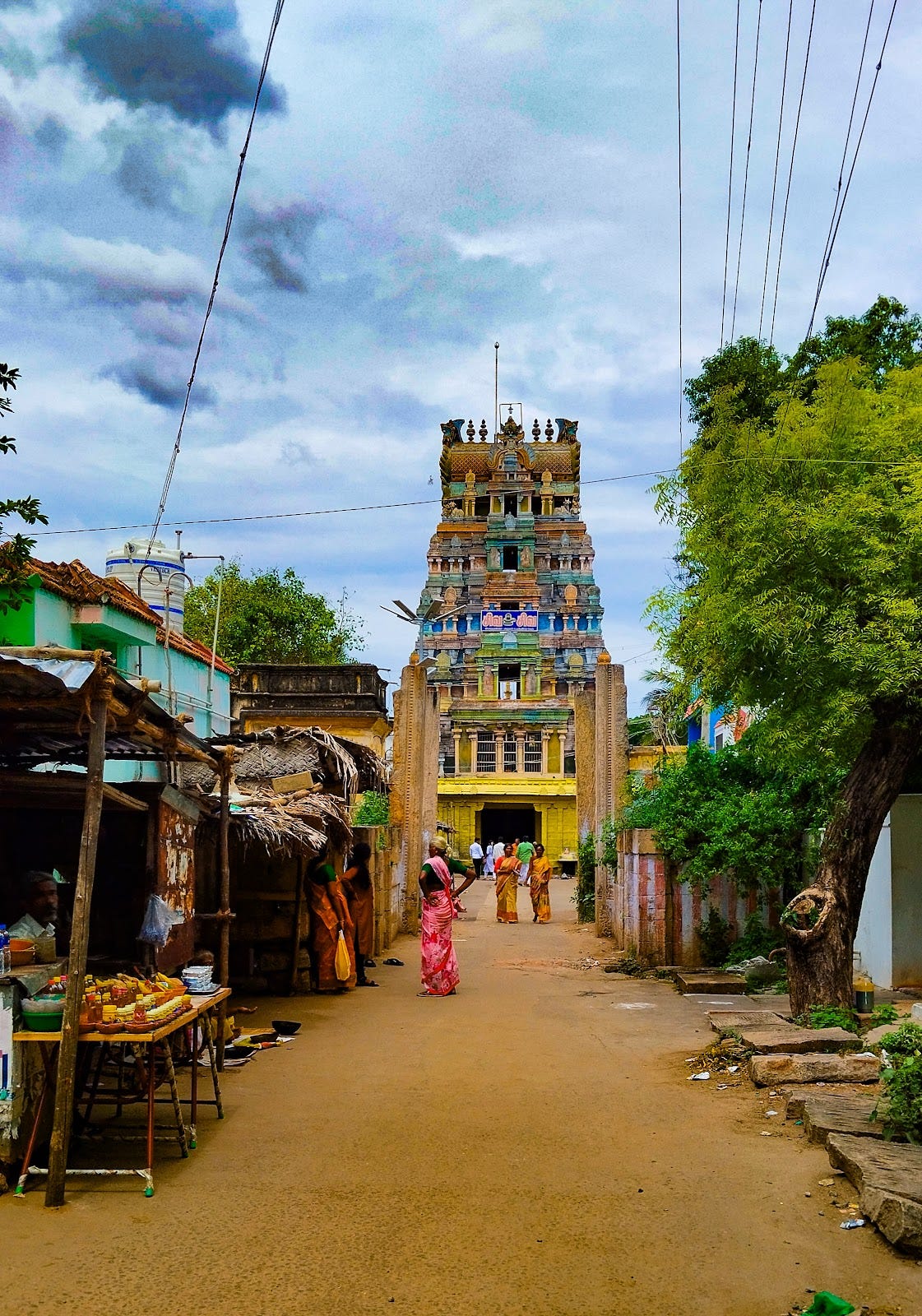
Did that make your heart flutter a little bit? The reason is that every human being is a little bit of a pagan deep down inside, and Hinduism is the world’s most sophisticated and developed paganism. If you took our advice and read The Ancient City, you may also have noticed that a lot of that ritual sounds very ancient Indo-European, and if you’re one of the 40% or so of human beings descended from them you may also be feeling your blood calling to you. At least, that’s how I explain the generations of European and American dilettantes, from Schopenhauer to the Hare Krishnas to that insane cult in Oregon, who have become inexplicably obsessed with Indian religion.
In Ka, Roberto Calasso has written a primer on the myths and stories that make up the imaginarium of that religion, but not the sort of primer one might expect. This is neither a dry, scholarly analysis of Indian myth and legend, nor is it a straightforward narrative recounting of them like D’Aulaires’ Book of Greek Myths. It’s something much weirder: a dreamy, hypnotic, psychedelic tour through the mythos, written almost as if you were a participant in its events. As the chapters roll by, so do the millennia, sometimes agonizingly slowly, sometimes with jarring time-skips. In doing so, it reveals just how much this myth world has changed.
The earliest known Hindu text is the illusive and mysterious Rig Veda. It features few of the “main” Hindu gods, and instead has characters like Indra, who bears more than a passing resemblance to Zeus (this is not a coincidence)5. Most of the gods of the Rig Veda are more like cosmic forces than personalities; for instance Agni is more a god who is fire than a god of fire (and yes his name is clearly cognate to the Latin ‘igni’). It is overwhelmingly concerned with sacrifice, and the performance of correct ritual, the acts whereby the cosmic order is maintained. Contrast that with the Mahabharata, an epic narrative like the Iliad or the Odyssey, concerned like most such epics with duty and loyalty, and like most epics fun to read. Two works, both “Indian,” but separated by almost two thousand years and inhabiting almost entirely different religious and moral universes.
Of course it didn’t stop there. Ka’s final chapters are about the Buddha. Yes it’s easy to forget that Buddhism was originally an Indian religion, since it now barely clings to life in the land of its birth.6 What even fewer Westerners realize is that Buddhism can be thought of as a “retcon” of the Vedic and Brahmanic tradition that eventually ripened into modern Hinduism. In the old world, the word ‘karma’ literally meant ritual action, before Buddhism transformed it into an internal spiritual disposition. The hereditary priestly cast of the Brahmins was reimagined as an aristocracy of virtue and enlightenment, something attainable by anybody through spiritual and ascetic struggle. Most jarring of all the gods themselves were not denied, but converted into lesser beings, demons really, deluded entities trapped in the cycle of saṃsāra, undeniably real but unworthy of sacrifice or adulation or worship.
Does this sound familiar? Yes, it’s eerily similar to the early Christian interpretation of Greco-Roman paganism. Really every bit of it. The rejection (or transfiguration into the eucharist) of the divine economy of sacrifice in preference of a focus on individual moral standing. The disintegration of the ancient ties of caste and clan, and its replacement by a brotherhood of believers (in some traditions, led by an enlightened elect). The wholesale rejection of the old gods, not denying their reality, but declaring them to be demonic tempters and misleaders of men. The Buddhist revolution and the Christian one are isomorphic in every way but one: the Greco-Roman tradition was completely overthrown and ground into the dust, while the Vedic tradition survived and eventually banished its wannabe upstart replacement.
Which makes modern India and modern Hinduism a kind of wormhole into an alternate universe where classic European paganism survived and prospered and matured philosophically and culturally. If you ever wondered what that might be like, you can go to India, squint a bit, and see it for yourself. Feel the crackle of the ancient Indo-European hearth-fire, see the thick social arrangements of the fratri, visit the Pythian oracle and participate in the Eleusinian mysteries. It’s too easy for fake neo-pagans to romanticize a past that never was, so if the thrill of Samhain or the Ashvamedha really moves you then I recommend going to a place that has really been shaped by a continuous tradition of polytheism. Perhaps you will find that you like it, and perhaps you will run screaming back to a continent where the old gods have been safely overthrown.
The Glass Bead Game: A Novel, Hermann Hesse (Holt, 1998).
We have a hard time imagining a future looking down upon us the way that we sneer at the past. Obviously we’re at the zenith of history and have discovered once and for all the correct way to order society and our personal conduct. On the rare occasions when we contemplate the fact that our descendants might look upon us with the same horror with which we regard our ancestors, we usually assume that it’s because they’re more progressive, more liberated, more whatever the thing is that distinguishes us from our culture war enemies and from our forebears. Hence the transgressive frisson we get when we read people like Robin Hanson or the writers of Games Workshop telling us that the future might be very much more like the past.
We can now add Hermann Hesse to that list. Yes, that Hermann Hesse. The esoteric Baltic German novelist with a penchant for Eastern religion.7 Hesse’s own fame follows a similar sort of parabola: for most of his own life he was unknown outside German-speaking countries, then he suddenly became a mega-popular international literary superstar for a brief period during the 60s and 70s. I’m too young to have experienced this myself, but I’m told that for a few years there every drugged-out barefoot hippie was quoting from Siddhartha. It’s hard to imagine today, when he’s back to relative obscurity, like social distancing or the Macarena.
In The Glass Bead Game, widely considered Hesse’s masterpiece, we are asked to consider a world a few centuries hence that looks back at the present day and shudders with horror. They refer to our era as the “Age of the Feuilleton” and are revolted by our intellectual and scholarly disorder. Their culture is rather like that of the High Middle Ages in Europe, before the Thomistic synthesis was shattered by Protestantism and secularism, or like the Neo-Confucian era in China before it was brought low by war and revolution. Their arts and sciences and philosophy form an integrated unity, and their scholars pursue quasi-monastic lives of contemplation in remote hermitages and castles, occasionally venturing into public to play or officiate at… the Glass Bead Game.
What is this game? Hesse never actually tells us. It suffuses every nook and cranny of this society, and so people never deliver exposition about it just like nobody ever explains to you how to breathe. But reading carefully, you can piece together hints: the game originated a hundred years or so after our own time, and was originally an analytic tool developed by musicologists to trace the evolving and interweaving themes of a fugue. Later, mathematicians realized that its abstract rules formed a universe that could represent any formal argument.8 Slowly, the game expanded to encompass every field of human knowledge, and all of them simultaneously:
A Game, for example, might start from a given astronomical configuration, or from the actual theme of a Bach fugue, or from a sentence out of Leibniz or the Upanishads, and from this theme, depending on the intentions and talents of the player, it could either further explore and elaborate the kindred concepts. Beginners learned how to establish parallels, by means of the Game’s symbols, between a piece of classical music and the formula for some law of nature. Experts and Masters of the Game freely wove the initial theme into unlimited combinations. For a long time one school of players favored the technique of stating side by side, developing in counterpoint, and finally harmoniously combining two hostile themes or ideas, such as law and freedom, individual and community. In such a Game the goal was to develop both themes or theses with complete equality and impartiality, to evolve out of thesis and antithesis the purest possible synthesis. In general, aside from certain brilliant exceptions, Games with discordant, negative, or skeptical conclusions were unpopular and at times actually forbidden. This followed directly from the meaning the Game had acquired at its height for the players. It represented an elite, symbolic form of seeking for perfection, a sublime alchemy, an approach to that Mind which beyond all images and multiplicities is one within itself — in other words, to God. Pious thinkers of earlier times had represented the life of creatures, say, as a mode of motion toward God, and had considered that the variety of the phenomenal world reached perfection and ultimate cognition only in the divine Unity. Similarly, the symbols and formulas of the Glass Bead Game combined structurally, musically, and philosophically within the framework of a universal language, were nourished by all the science and arts, and strove in play to achieve perfection, pure being, the fullness of reality.
The Games are not played competitively, rather they are authored, individually or collaboratively. People may (and often do) play the Game by themselves at home, but the greatest Games are public affairs conducted under the supervision of a public official, a great Master, or even the Ludi Magister himself. These public Games are solemn affairs with a liturgical dimension, in which participants and observers are expected to wear ceremonial clothing, to live ascetically during the Game’s duration (which can last days or weeks), and to engage in deep, shared meditation after each move of the Game. The Game subsumes religion and research and musical performance and speculative philosophy into a single unified vocabulary and practice. It is the “unio mystica of all separated members of the Universitas Litterarum,” a complete synthesis of all the intellectual dimensions of life.
Doubtless when Hesse wrote this, the idea of a universal encoding of all intellectual concepts that preserves Wittgensteinean similarity and structure relations seemed ridiculous. Of course, that was before word2vec. It isn’t a crisp analogy, after all latent representations in word2vec are squishy things, not crisp formal symbols that you can play a game with, but are we really sure that in a year or two we won’t be able to create a neurosymbolic hybrid whose neuralese looks a lot more like the Glass Bead Game? How ironic then that our present socio-cultural evolution looks to be going in the exact opposite direction: instead of a monolithic, ritualized, and fully integrated scholarly universe; a world where every man and every model context are their own individual feuilleton.
How many of you are now agents in both sense, I wonder.
I’ve always been a bit puzzled by people who read The Left Hand of Darkness as a queer or transgender work, since the entire point of the book is that the inhabitants of Gethen underwent genetic modification that gave them an entirely different biological nature from baseline human beings.
There are hints in the book that the Cetians are covered in a thin layer of fur, but since the story is told from the Cetian point of view nobody ever remarks on it. There’s clearly some visual difference though, since they’re repulsed by the appearance of the “aliens” from Earth.
It’s basically The Moon is a Harsh Mistress but with communists. I don’t know if this was meant as a deliberate take-that to Robert Heinlein, but one has to wonder.
The Rig Veda may actually document the invasion of the subcontinent by the Proto-Indo-Europeans.
The same is now true of Christianity, largely thanks to American foreign policy.
I had assumed that this was a sly reference to Grothendieck’s Dessin d’enfants, but wait! Hesse wrote this decades before Grothendieck!
"Did that make your heart flutter a little bit?"
Nope. It made my stomach turn a bit perhaps, but that's about it.
Well, if Mr. Psmith does not read the comments, what is the point of having a Comments section?
It reminds me of a factory I worked in many years ago. There was a Big Red Button on the wall that we were assured would bring the whole place to a standstill if pushed -- but obviously the button should only be pushed in a life-or-death situation. No-one ever pushed the button, and thus we all suspected it was not connected to anything and would not really stop the line. Is this Comments section analogous to that Big Red Button?