

1939: The Lost World of the Fair, David Gelernter (Avon, 1996).
During one of our recent bouts of “everyone is home sick and Mom is increasingly grumpy about it,” we watched Disney’s 1940 classic Fantasia. It was just as good as I remembered (I consider my transition from preferring the pretty girl centaurs of the Pastoral Symphony section to Night on Bald Mountain to be evidence of thirty years of character development), but this time around I was mostly struck by the narrator.
I’ve watched a fair number of documentaries for children, and they tend to share a certain “let’s explore” tone: I, Morgan Freeman (somehow it’s always Morgan Freeman), will intone sententious descriptions of how Deeply Meaningful this footage is, and then we’ll marvel together at the wonder of…penguins, or baby elephants, or whatever defense contractor has sponsored the latest IMAX film about space. It’s not quite the voice of an equal (you don’t cast Morgan Freeman to be an equal), but it lowers itself. It narrates. It accompanies. It knows more than you, but only because it’s already seen the movie; your five-year-old could probably provide the same description of sunrise at the South Pole after a couple of screenings and a pack of cigarettes.
The voice of Fantasia is different. Here the narrator is an expert, in fact as well as tone: Deems Taylor, who did the voiceover, was a noted midcentury composer, music critic, and commentator who helped pick the pieces for the film. And despite the cutesiness of his chitchat with Mickey Mouse, he does come off as an initiate of a high culture to which he’s admitting the audience. He describes the music, the animation, and the artistic choices from the inside:
Now, there are three kinds of music on this Fantasia program. First, there’s the kind that tells a definite story. Then there’s the kind that, while it has no specific plot, does paint a series of more or less definite pictures. Then there’s a third kind, music that exists simply for its own sake. Now, the number that opens our Fantasia program, the Toccata and Fugue, is music of this third kind, what we call absolute music. Even the title has no meaning beyond a description of the form of the music. What you will see on the screen is a picture of the various, abstract images that might pass through your mind if you sat in a concert hall listening to this music.
The voice of Fantasia is, in other words, the voice of authority. This man knows better than you do. He deserves your respect and your deference, and even if you never go from your 1940 movie theater to the sort of concert hall that plays Bach, you’re supposed to come away from the film — excuse me, the picture — believing Bach is something that matters.
This is also, according to Yale computer scientist David Gelernter, the voice of the 1939 World’s Fair.
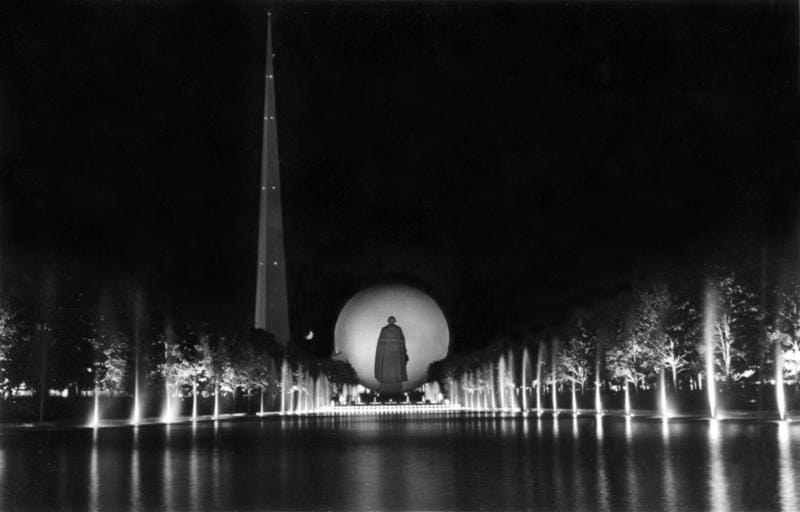
You’ve probably heard of World’s Fairs in the context of the 1851 Great Exhibition in London (which gave us the Crystal Palace), the 1889 Exposition Universelle in Paris (which gave us the Eiffel Tower), or the 1893 World’s Columbian Exhibition in Chicago (which gave us H. H. Holmes’s Murder Castle). You may even have heard of the 1967 International and Universal Exposition in Montreal (which gave us a name for the Expos), though I had not. I definitely hadn’t heard of Expo 2025 in Osaka. In fact, before I looked it up to write this, I had no idea World’s Fairs still happened. They’re not big deals the way they used to be.
Part of that, of course, is that there just aren’t national — or, God forbid, international — big deals these days. When we get our news from an algorithmically-curated feed instead of a paper or an authoritative voice over the airwaves, the things you hear about and the things I hear about may be very different. It takes a singular shocking event to smash through the borders of our balkanized information landscape, and even then the unity doesn’t last long. Then, too, we are tremendously richer than we were and can sustain tremendously more stuff happening, so any given event is less exciting. I can’t even remember the last time I watched the Olympics, aside from a beach volleyball semifinal I caught by accident in the orthodontist’s waiting room. (Germany vs. Norway. Very exciting. I had not previously realized what seven-foot-tall northern Europeans do now that it’s illegal to be a Viking.)
1939 was different. In 1939 New York City was the American city, the “nation-dominating pinnacle,” and New York was the city of the Fair. Its theme structures — “a slender three-sided pylon…a good 50 feet higher than the Washington Monument” called the Trylon, and the great round Perisphere 180 feet across — stood side by side in their Queens meadow but were visible all the way from Manhattan, as well as appearing nationwide decorating “advertisements and road maps, Remington portable typewriters and Bissell carpet sweepers, RCA radios and Kodak cameras, children’s games, women’s print dresses and untold thousands of souvenir doodads.” (A stylized version also festoons section breaks in 1939.) The fairground, designed by Robert Moses, was three and a half miles long and a mile wide, and featured such attractions as General Motors’s “Futurama” ride, which flew you through the world of 1960:
…Futurama took you on an imaginary flight across America from coast to coast. The landscape in soft greens and browns wasn’t based on any actual coast-to-coast slice of the country, but each feature was modeled on a real locale. There were frequent changes of scale, to give you the sensation of swooping down closer or riding higher in your cross-country flight. “You somehow get an almost perfect illusion of flying,” The New Yorker observed. You encountered cities of the future along the way: Their skyscrapers were thrusting tall boxes with rounded edges and wraparound glass walls, vaguely Miesian. … You pass fantastic and imaginative details along the way. A suspension bridge hanging from one graceful, central tower. A blimp hangar on a round floating platform that can be pointed in any direction. In an apple orchard “the fruit trees bear abundantly,"“ says the narrator, “under individual glass housings.”
The whole fair was organized around the promise that it was “Building the World of Tomorrow.” The AT&T building had long-distance telephones. The RCA building had the “radio living room of tomorrow” complete with fax machine. Inside the Perisphere was Democracity, a massive model of a modern city, no “planless jumble of slum and chimney” but a sparklingly utopian world of suburbs and planned architecture. Above the diorama, a film projected on the acre-and-a-quarter screen of the interior of the dome showed farmers, teachers, engineers, miners, and other professions converging on the city to bring it to life.
And on and on. 1939 is a guided tour of the Fair, pausing and zooming out from time to time to provide broader cultural context. (The mention of Moses, for instance, gets a couple of paragraphs of potted history and a few remarks Gelernter means to add nuance to the picture presented in the Caro biography, which I would probably have found more interesting if I had read the Caro biography.) But it’s also a guide to the Fair’s ethos, as synecdoche for the ethos of late 1930’s America.
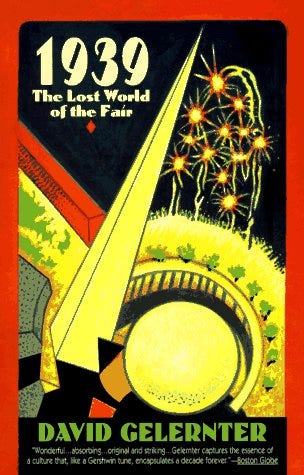
This is a weird, weird book. It’s not quite fiction, though one of the major through-lines is the made-up story of an old woman’s youthful romance. It’s not quite history, despite the generous explanations of who/what/when/where in re: the Fair, because it spends so much time telling you What It All Means. And it’s not quite political theory in the traditional sense, because political theory doesn’t typically include passages like this one, from the end of the prologue:
The best of all reasons to return to the fair is that travel is broadening, and time travel most of all.1 My tour aims to make it possible, however dimly, to see the sights, smell the smells, hear the sounds, eavesdrop on the conversations, try on the anxieties and exultations; buy a hot dog in a roll wrapped in a paper napkin from a white-jacketed someone, hand over your dime, look hard at the man’s translucent root-beer eyes until he turns away. … Draw mustard with a spoon onto your hot dog. … Turn around and take a bite slowly, facing the Trylon and Perisphere at the far end of a thronged avenue. Then, as the sun burns through and pulls the shadows back into focus and you find that you are standing right at the tip of the Trylon’s, smile. Have another slow bite. Reflect that the Perisphere looks to you the way a distant golf ball must look to a very small ant. Hear someone speak your name. (If you would add to this scene the imagined sound of your name, the author would be grateful.) Turn round again and smile wide. The 1939 New York World’s Fair is one amazing show. It still stands undisturbed on Flushing Meadow, just over the edge of time; it would be an unforgivable shame to miss it.
Of the books I’ve read recently, the closest analogue is probably Akenfield. They’re both portraits more than anything else, impressionistic depictions of a particular time and place that depend on texture, taste, and feel as much as facts. They’re trying to capture the Zeitgeist, which is German for “vibes,” and they both treat a liminal moment, a world on the brink of vanishing. But where Akenfield is ambivalent — much was lost, but Blythe refuses to succumb to nostalgia — Gelernter’s image of the past is less complicated. His 1939 is a golden age of civic order and confidence in American mastery of a “good, bold, brilliant future,” all of which was lost in the degradation of the 1960s. If you tilt your head, this is ironic: Gelernter wrote a book about contemporary society being a disaster for the human race while still recovering from having his hand blown off by the Unabomber, who thought something similar (but put the beginning of the end earlier).
It’s also the most profoundly neocon thing I’ve ever read, and I used to read the Weekly Standard.
I don’t mean this is the sense of foreign policy, though that’s undeniably part of it: Gelernter was a major cheerleader for the Iraq war, and his columns — which probably had a meaningful influence on American conduct in the Middle East — are perfectly in line with the observation that “[t]o be neoconservative is to bear almost daily witness to the resurrection of Adolf Hitler.”2 And yes, the specter of war in Europe does lurk over 1939’s horizon, implicitly and explicitly. The Fair combined industrial might, technological prowess, and an earnest self-confidence in its World of Tomorrow; Ernie Pyle’s description of Operation Husky3 “pouring men and machines into Sicily as though it were a giant hopper. … America’s long-awaited power of production finally rolling into the far places where it had to go” is the same picture transposed. Even our introduction to the Trylon and Perisphere closes with: “Four thousand tons of steel went into the Theme Center. The United States won the Second World War with weapons made, in part, from the scrap.”
But it’s much deeper than a caricatured “Hitler bad, therefore American military interventionism good.” There’s real thematic (rather than just biographical/genealogical) continuity between the sort of neoconservatism propounded by James Q. Wilson, Pat Moynihan &c. in the 1960s and 70s, when it was basically social science telling you the same thing as the editorial board of National Review but for different reasons, and the 2000s hawk version from Bill Kristol and — well, David Gelernter. Conservatism, insofar as it’s a meaningful term at all,4 means looking back at some World of Yesterday with the desire to retvrn, and the neo- of the neocons was about where they thought things had gone wrong (as well as about when they thought the going-wrong started). The Southern Agrarians wanted, uh, southern agrarianism; the neocons wanted America-2, the vision of America that emphasizes industry and skyscrapers and the man on the moon, kids playing stickball on a street in the Bronx.5 They weren’t thinking about backwoodsmen and church steeples on the village green — they were thinking about civic order on a massive scale combined with belief in ourselves and our technocratic future, and if you follow that longing to its logical conclusion it takes you to both City Journal and The Weekly Standard. (If all this sounds rather vague to you, you can find a pretty decent history of neoconservatism here; it’s longer than the Wikipedia article but much shorter than any of the books on the topic. Alternatively, just imagine the first generation of neocons as Charles Fain Lehman.)
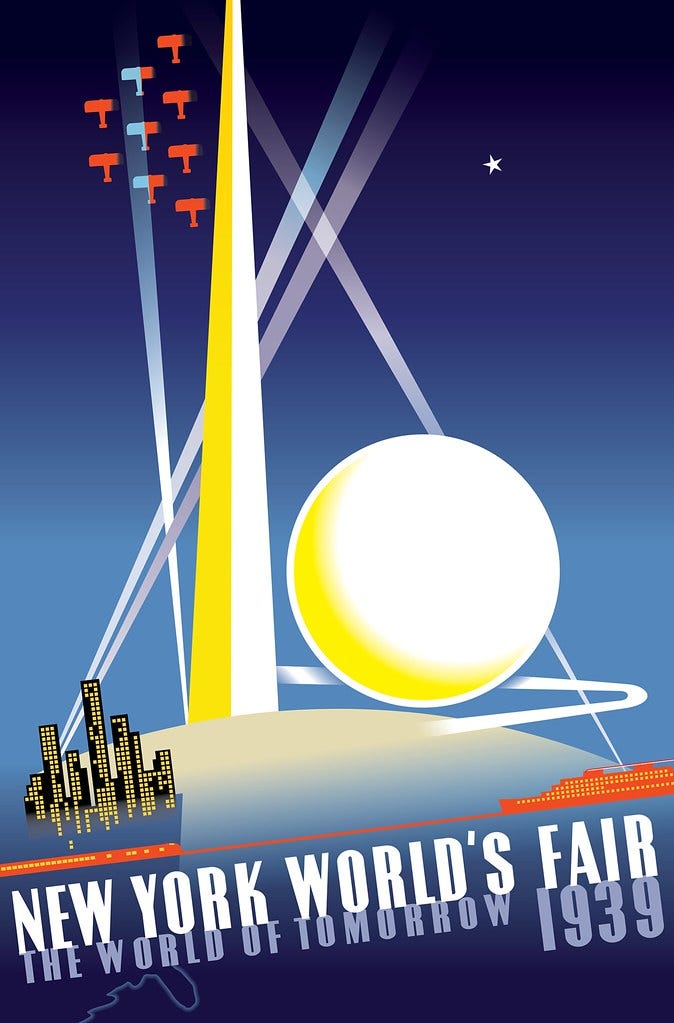
So what about the past does Gelernter miss, exactly? Not the hot dogs or the modernist architecture, certainly not the sterile suburbia of the Futurama and Democracity — he freely grants that much of what was razed to make room for “the future” was pretty nice. No, he misses the vibe. More specifically, he misses the faith in technology, in the future, and in ourselves.
In 1939, technology was heroic. It had electrified the factories, brought running water to the masses, simplified the housewife’s life, let us cross the continent in record time. And more:
Technology meant refrigerators and radios. It was about new ways to build bridges, dams and skyscrapers, not about space stations and supercolliders. It was about nylon stockings—available as of December 1939—and rayon and cellophane. It was about elevators. …
At the groundbreaking ceremony on Flushing Meadow, La Guardia turned up the first clump of earth with a rusty 150-year-old spade. “This is the way they did it 150 years ago,” he couldn’t help but remark; “over there,” pointing to a steam shovel, “is what we use today.” It’s been a long time since we were capable of taking pride in a power shovel.
The fairgoer was meant to get a glimpse of a glittering future. The narrator of the Futurama exhibit told you that in his imaginary 1960, “Man has forged ahead since 1940. New and better things have sprung from his industry and genius.” But note that tone of voice: the Fair, when it told you about the future, spoke with authority.
In fact, all of American society spoke with authority. There were standards. There were distinctions:
In 1939 distinctions were maintained between the way children dressed at school and at home, the way they addressed an adult versus a friend, the way boys were treated versus girls, ladies versus gentlemen (a gentleman, for example, invariably stood as long as any lady in the room was on her feet), between those who were entitled to call you by your given name and those where were not, up staircases and down, Sundays and other days, black and whites, Jews and gentiles, Chevrolets and Pontiacs, misses and missuses, legitimate offspring versus bastards, married couples versus those living in sin, … the status of high culture versus low (the only virtue of a certain Gershwin concert in 1936, one critic wrote, was that it made “a certain class of people conscious of such a thing as a symphonic ensemble”), loiterers versus law-abiding citizens, … words you might speak versus words fit to print, the subjunctive mood versus the indicative (“even though he perform this office himself…”), behavior allowed in private versus what might appear in a picture magazine versus what might appear on screen; plus hundreds of others, nowadays lapsed or outright despised.
There is nothing to justify ambivalence about the steep decline of racial discrimination and anti-Semitism that has taken place in this country since 1939. It is the direct result of allowing distinctions once rigidly enforced to lapse. But, troubling though it may be to admit, that steep decline is part of a broader phenomenon with dangerous consequences.
Some of the lost distinctions have practical consequences: it’s better for children when they’re raised by married parents, for example, so a general cultural nonchalance about cohabitation and out-of-wedlock births is a bad thing. (Mr. Moynihan, call your office.) A lot of them were morally irrelevant, though; there may be real value to distinguishing some occasions by dressing nicely for them, but the specifics — the necktie or the high heels — are completely arbitrary. A society that distinguishes between children born to married parents and those who aren’t is meaningfully different from a society that distinguishes between children born on weekends and those who aren’t. The same doesn’t hold for a society where men wear ties in public versus a society where they wear ruffs in public. And then, of course, Gelernter readily concedes that some of the distinctions were bad! But you can’t separate them, and they were upheld simply “because they were rules. By honoring the traditional distinctions—between sacred and profane, priest and layman, holy and ordinary day, kosher and trayf, saint and sinner—the faithful are made to feel part of one community, and worthy of the rewards they are promised.” Behold, the utilitrad.
The religious language Gelernter uses above is quite intentional, because he argues throughout 1939 that America in that era was a “deeply religious” society. Not Christian specifically, although it was largely Christian (Gelernter himself is Jewish and peppers the book with glimpses of New York Jewish life), but motivated by the American civic religion:
A society is religious when its typical member subscribes to certain beliefs on emotional, not rational, grounds, accepts certain obligations, expects certain rewards and feels himself to be a member of a community of believers. The central tenet of the American religion was, of course, that American democracy is good and right, for America and for the whole world, and is destined ultimately to supercede tyranny everywhere. Look around you at the World’s Fair, New York’s Governor Herbert Lehman declares. “On every hand there is symbolized something far more precious than material progress—our faith in our destiny and our confidence in our future.” “It is a young nation,” he says of America, “that has had only thirty-two rulers. It is virile and imaginative; capable and resourceful. Free men everywhere look to our land for leadership and guidance.” La Guardia affirms the belief. The New York World’s Fair will be dedicated, he says, “to the future of the American people and the glory of the country.”
The rules and distinctions, even the arbitrary and bad ones, served to unite Americans in pursuit of a utopian technological and (ultimately political) project, and all the elements of that project — the men in neckties on their best public behavior, the authoritative voice, the optimism, the whole great glorious glittering future — were on their clearest display at the Fair.
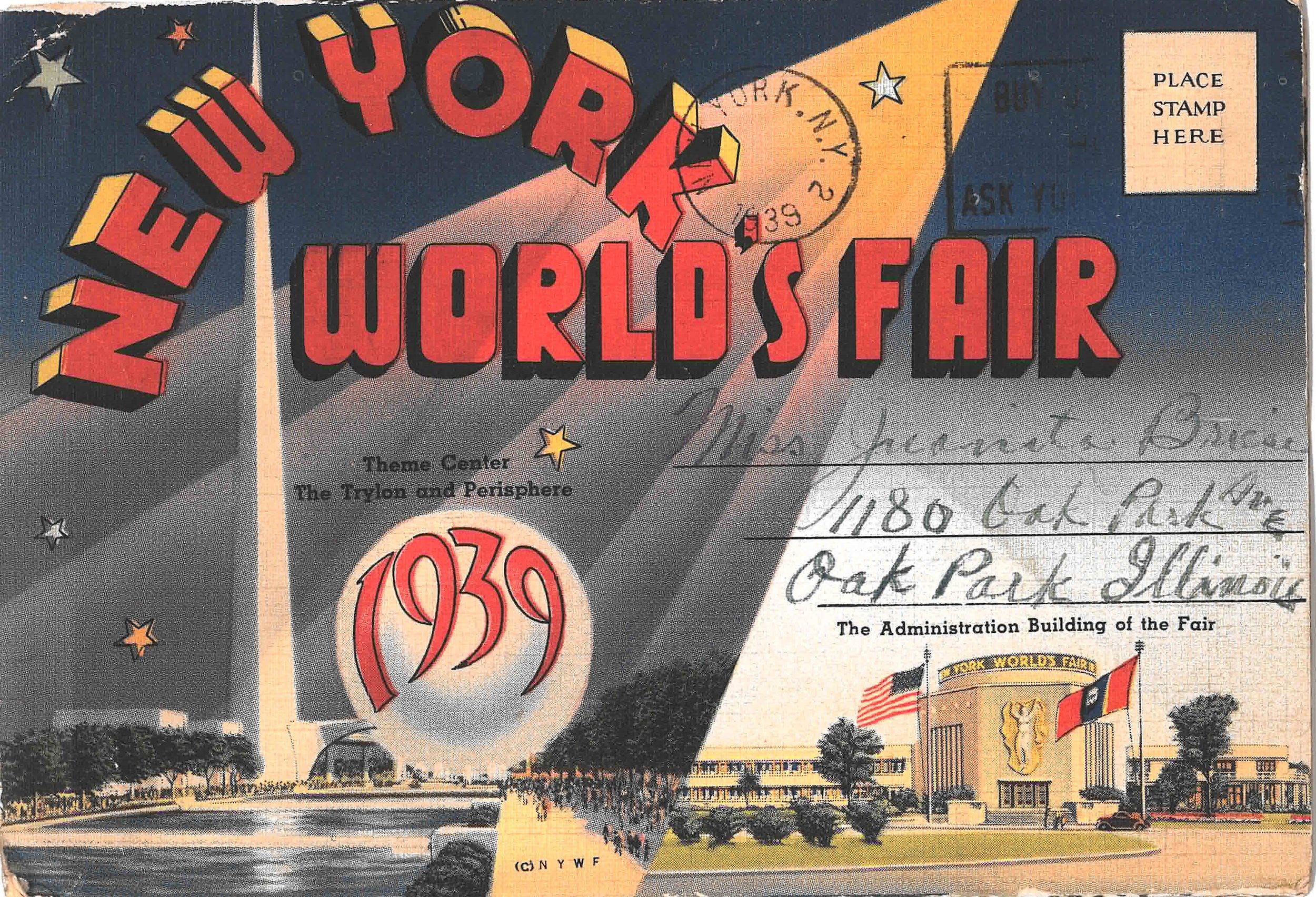
And then we got there. That’s the really remarkable part. The Romans never managed imperium sine fine. The medieval Christian dream of one fold and one shepherd never came true. But for a generation after 1939, the Fair delivered: we built the superhighways the Futurama promised us, went to live in the suburbs of Democracity, and furnished our homes with all the consumer products RCA and Westinghouse and DuPont cared to show us. We live vastly richer, vastly easier lives than we did in 1939, in exactly the ways the Fair said we would. We live in the World of Tomorrow.
Gelernter thinks that’s precisely the problem, because the dream was never living in utopia; it was getting there.
…a religion that has seen its promises realized is bound to crack apart. It has served its purpose. And today the American religion—in the passionate intensity of its heyday—is dead, is a mere memory. America exists today in a post-utopian twilight.
… The fair was a credo in stucco and steel. Behind the fair and its theme stood “a group of forward-looking young architects, city planners, industrial designers, sociologists and young visionaries from many walks of life.” They shared “a fundamental conviction”—that the fair ought to deliver a “powerful,” a “prophetic” message. Fundamental convictions, powerful prophetic messages are words that came naturally to the New York World’s Fair. It was the mountaintop. Fairgoers ascended and looked out at the promised land.
…[the Fair] was the Daniel, Ezekiel, Isaiah, Revelations [sic] of the American religion. Not the basic meat-and-potatoes but the ecstatic closing vision. The fair laid out the end of days. And having studied the fair, I think we will see that we are adrift, at least in part, because we are no longer marching toward utopia: We no longer can, because we are in it. And we will understand, too, that the fair ought to be approached today with the respect for its fundamental strangeness accorded by all civilized people to the shrine of a dead faith.
That’s all good as far as it goes: yes, we got there. Yes, we live (lived?) in what was yesterday’s World of Tomorrow, and a person can’t be motivated by a destination once they’ve gotten there. But traditionally you keep going. You’ve climbed the mountains and forded the rivers and mapped the depths of the ocean? Okay, how about space? And yet somehow we stopped. Why? Yes, we still have World’s Fairs. They still articulate hopes for the future. (Osaka’s Expo 2025 was titled “Designing Future Society for Our Lives.” The losing bids from Baku and Yekaterinburg were on the themes of “Building a Better Future” and “Changing the World.”) But come on, really? You can feel the air going out of this project. We’ve lost faith in ourselves and in our future, and it’s not because we’ve achieved utopia. We’ve lost faith because we got there and it turned out it wasn’t utopia at all.
The voice of “I know better” authority that Fantasia deploys to welcome you to high culture is also the voice that sent hundreds of thousands of Americans to Vietnam. The “slum clearance” intended to build the modern, planned Democracity and the superhighways that serve its suburbs destroyed the cities. The internal contradictions between the “distinctions” that provided cultural cohesion and the nation’s avowed faith in individual freedom and equality tore the civic religious community apart — were, in fact, already beginning to tear it apart in 1939. The decent drapery of life can’t survive rational examination: when you abandon the traditional distinctions in a few extreme cases, you lose the neckties and the ma’am, too. I’d like to think that all the sliding past that was historically contingent, but the Great Society spoke with the same voice as Vietnam and now we have nothing to point at but social science data when we argue that people shouldn’t be allowed to nod out on Main Street.
Bits of the Fair’s world persist. The vestiges of authority can be found here and there, but they’re fractured and rarely universally recognized: every time an authoritative institution is publicly incompetent, a little more of its authority trickles away. The believers in technology and “Tomorrow” are more obvious — the Wizards will always be with us — but their voice is no longer that of authority. Marc Andreessen’s “Techno-Optimist Manifesto” is a compelling piece of writing, but he’s trying to convince and inspire you, not demanding the deference no one gets anymore. The same is true of the Progress Studies crowd and the Greater Patrick Collison Co-Prosperity Sphere more generally. Partly this is just a general cultural shift, but partly it’s that today’s technological contributions are hard to notice.6 (And where we’re poised on the edge of big, obvious ones, the people in the know aren’t entirely sure they won’t kill us all, which does not inspire confidence.)
The world of the Fair is fascinating to visit because it’s one of those golden ages, like classical Athens or Renaissance Florence, when the dynamic tension between license and tradition holds a culture balanced on the brink before it inevitably plummets to its fiery destruction.
But boy, what a show.
Considering making “travel is broadening, time travel most of all” my personal book-selection motto.
I had to Google to find out where this line came from (it was a book review by Timothy Noah) but it apparently stuck in my head verbatim for eighteen years so I think it’s a pretty good one.
Disambiguation: "Invasion of Sicily" redirects here. For the Athenian offensive in the Second Peloponnese War, see Sicilian Expedition. For the 1860 conquest of Sicily as part of the Unification of Italy, see Expedition of the Thousand. I can’t decide if my new favorite thing men do is them invading Sicily or them arguing about which Wikipedia article about invading Sicily should be the canonical one.
I have opinions about this and they are best summarized as “uh, maybe,” not least because arguably the anarchoprimitivists do this too and are pretty clearly left rather than right. At the point that we start saying things like “left conservative,” we have reached the invasion of Corcyra and words have lost their meaning. “Conservative” is sometimes a useful relative term but “left” and “right” actually mean something.
My touchpoint for this will forever be Peter Beagle’s “The Stickball Witch,” collected in We Never Talk About My Brother. It was one of five connected short stories based on his childhood that he recorded for a podcast that now seems to have vanished completely, and it scratches that time travel itch in a highly satisfactory manner.
Improvements in compression algorithms, public-key cryptography, and content-delivery networks may have meaningfully improved people’s lives, but the infrastructure is invisible to the end user. New cancer drugs, or even cooler stuff like siRNA therapeutics, can promise huge increases in health, but “this bag of medicine we’re putting in your arm is more effective than the old bag of medicine we used to put in people’s arms” is just less exciting to a patient than the shift from “welp, guess we’ll hope your bacterial infection improves!” to the actual ability to treat you even if the lifespan improvements are comparable. (And they’re not, at least not yet.) The containerization, global supply-chain management, and statistical process control that let me quickly and cheaply replace my defunct washing machine with a lovely new one manufactured in Mexico by a Korean company and sold by an American warehouse store only matter because I’m an “I, Pencil” weirdo, but the invention of the washing machine was obvious to every housewife in America. Cheap ubiquitous LED lighting is not as impressive as rural electrification. And so forth.
I'm not sure I have ever felt more targeted than in an essay about a book about the world fair using the sentence "the Greater Patrick Collison Co-Prosperity Sphere".
“But the country's disintegrating. What's happened to America? What's happened to the American dream?“
“It came true. You're lookin' at it.”
― Alan Moore, Watchmen