

Anabasis, Xenophon (trans. Shane Brennan, Pantheon, 2021).
If you hang out much with finance bros (or “capital allocators” as they now call themselves),1 you may chance to hear somebody described as an “operator.” What is this strange species? What is this unusual job with an unusual title? Near as I can tell, an “operator” is somebody who actually runs a real business in the real world. But atop the commanding heights of 21st century America, that makes you an anomaly. You have no podcast. You have no portfolio of bets. You have no LPs, no byzantine leverage structure, and no IRR calculations. You don’t flit from deal to deal, hovering on a castle of financialized abstractions so ethereal the lack of air pressure at that altitude gives you a nosebleed. You aren’t even an intellectual or a scribbler who writes about real things at a layer of remove. No, instead you toil in the muck, doing basically the same thing every day, trying to make an actual business actually succeed. What a weirdo.
I’ve always been a little suspicious of people who talk about doing things without ever having done them. That goes for most journalists, professors, and middle managers. “Capital allocators” are fine, so long as they’re talking about allocating capital, which I have no reason to doubt that they are very good at. But I roll my eyes a bit when they talk about building great companies if they have not, personally, themselves built a great company.2 Many philosophers both ancient and modern have the same problem — but not all of them. For instance, Socrates was a war hero! And that brings me to his student Xenophon: two years ago I read his fictionalized biography of Cyrus the Great and I loved it. But as I read it and loved it, I was gripped with foreboding. Who is this guy who’s saying all these smart-sounding things about the nature of leadership and greatness? Is he just some random guy who hung out at a bunch of Athenian dinner parties and came up with nice-sounding theories about virtue? That would be a huge let-down. But I’m happy to inform you that that is not the case. Xenophon knew what he was talking about.
Xenophon was an operator.
You see, as a young man, Xenophon got himself into a bit of trouble. He came of age during the dying days of the Athenian democracy, in the final, grinding stages of the Peloponnesian War. Following the disastrous Sicilian Expedition in 413 and the subsequent intervention of the Persian Empire on the side of Sparta,3 Xenophon’s family had to evacuate their ancestral estate in Attica, and the boy was raised entirely within the city walls. He fell in with the Socrates crowd, who were more than a little anti-democratic in their intellectual inclinations (very carefully of course), and he also had the all-too-human admiration for the nation that was currently crushing his.
Following their victory, the Spartans unwound the Athenian empire and installed puppet governments in various cities including Athens. They preferred oligarchies, since that was the form of regime that most resembled their own.4 They didn’t meet a ton of resistance; the young Xenophon was no outlier, and in the wake of her defeat Athens was full of anti-imperial, pro-Spartan, and pro-oligarchic currents. Thus the Thirty Tyrants came to power, and Xenophon served them as a cavalry commander crushing democratic insurgents. Eventually however, the insurgency won, Socrates was murdered by the new super-ultra-democratic government, and Xenophon decided that it was maybe time to get out of town.
As luck would have it, there was somebody else hiring cavalry commanders. Following the death of the Persian emperor Darius II (not to be confused with Darius the Great who led the first invasion of Greece), there were two brothers who both claimed the throne: Artaxerxes II (not to be confused with Artaxerxes I who appears in the Biblical book of Esther) and Cyrus the Younger (not to be confused with Cyrus the Great whom Xenophon, confusingly, wrote a book about).5 As the elder brother, Artaxerxes technically had the right to rule. But many people in the Persian court thought that Cyrus was cooler, handsomer, more warlike, and better in every way. And so, egged on by their mother Parysatis, Cyrus secretly hired an army of mercenaries to supplement his regular troops and tried to launch a coup against his brother.
As with all coups, speed was of the essence. Xenophon estimates that Emperor Artaxerxes could field an army of 1.2 million men. Even if that’s an overestimate, it was a very large army — much larger than the relatively tiny force under Cyrus. But the thing is, the Persian Empire sprawled overland, and it might take months for Artaxerxes to get all those troops to his capital. If Cyrus could get there before most of them, and could win decisively with the force he had, that might be enough to end the civil war before it began. Even so, he would be vastly outnumbered. But Cyrus knew that when Artaxerxes took the field against him, he would have to take the traditional Persian king’s position at the center of the army. So the linchpin of his plan was to hit the center of his brother’s line with an armored fist comprised of the best heavy infantry in the known world (Greek hoplites), break through their defenses, and then send cavalry swooping in to kill Artaxerxes so that the rest of the Persian army would have no reason to continue fighting.
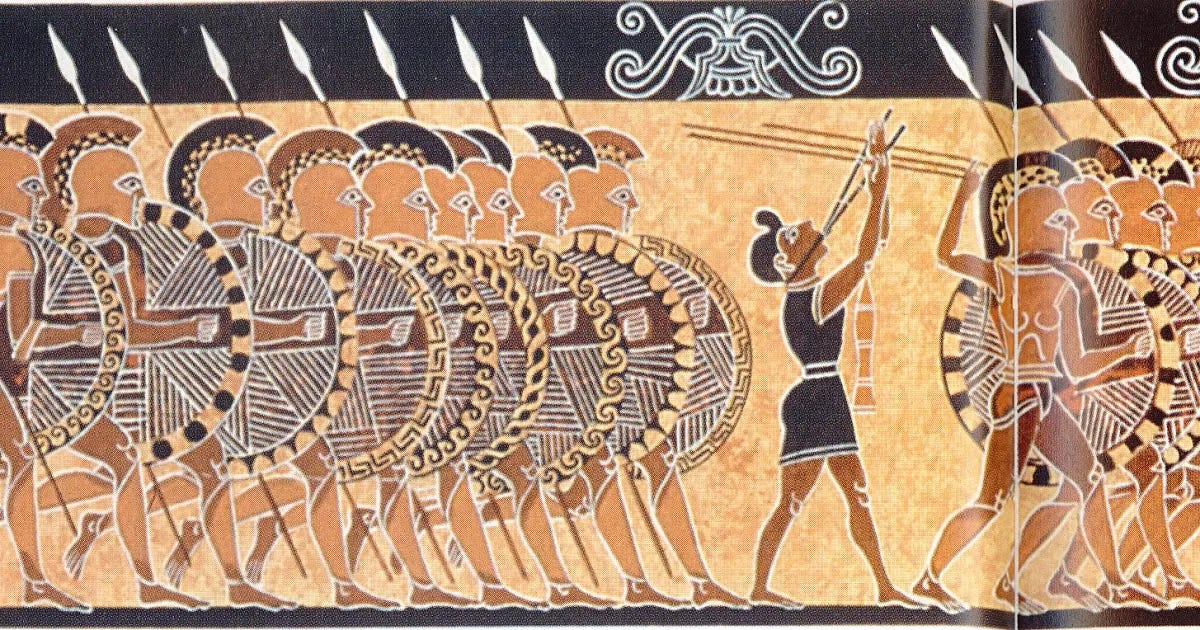
So Cyrus was in the market for Greek mercenaries, and with the Peloponnesian War over there were lots of idle soldiers in every part of Greece — Xenophon among them. His Anabasis (literally “the march up-country”) is their story. It opens with ten thousand Greek mercenaries arriving under the overall command of a Spartan general named Klearchos and joining Cyrus in Asia Minor, where he lies to them and says he is hiring them for a punitive expedition against some rebellious tribes. The deception is important — to rebel against Artaxerxes and to challenge his vastly more powerful forces is completely suicidal — and the deception works. The Greeks don’t figure out what the real plan is until they are deep into Mesopotamia with the Persian army already alerted about their invasion. At that point, Klearchos decides that their best odds of survival are to follow through with the plan and convinces the others to go along with it as well.
As people who are in some sense heirs and inheritors of Greek civilization rather than of Persian (no offense to the five Psmiths subscribers who live in the Islamic Republic of Iran, we love you), this book is disorienting to read. The Persians are ambitious and scheming and civilized and decadent in an oh-so-familiar way, whereas the Greeks are clearly the “barbarians” of the story — a band of psychotic killing machines obsessed with honor and plunder. If you’ve read the Iliad, this should come as no surprise. The things we associate with classical Greece, the philosophers and the democracy and the rest of it, were a bizarre aberration that we remember in part because it was so unlike the rest of the society that incubated it.
The Greeks in this book really feel like the Indo-European steppe horde that they were descended from. You can practically hear the baying of the kóryos. They are constantly hungering for battle, constantly capturing slaves for menial or sexual purposes, and constantly bragging about it. I’m sure some of this is an unfair comparison because the Persians we meet are closer to the median Persian whereas the Greeks are an all-male band of elite mercenaries, and Bronze Age gonna Bronze Age. But really, the distinction is too stark for that to explain all of it. And after all, this is why Cyrus hired these guys! He wanted them for their fearsome efficiency at butchery, and for their reputations of the same. It’s notable even in how the Greeks speak to one another. Have you ever read the Norse sagas? It’s a lot like that — all deadpan understatement and litotes and sarcasm. Perhaps it’s not a coincidence that the word “laconic” originally derives from a location in the Peloponnese. The similarities between the Norse and the Greek ways of speaking actually got me wondering if this particular way of talking is common to barbarian warrior societies. It couldn’t be more different from the Persians who talk, well, kind of like Americans — wheedling and pompous and always trying to make a deal.
The other way in which the Persians seem far more normal is in their gender relations. Like most agrarian societies they’re patriarchal, but as a decadent empire they’re hardly Victorian in their mores. Cyrus rides to war with a modest set of courtesans and female groupies, and at one point cuckolds a nobleman who hosts him, but he also listens to these women and often takes their advice. His mother Parysatis was an extraordinarily powerful woman with her own intelligence network, who had effectively run Darius’s government. In contrast, the classical Greek attitude towards women was beyond Victorian, more “Saudi” (as occasional guest poster Gabriel Rossman once put it). And what the Greek mercenaries lack in emotional and physical intimacy with adult women they make up for with prepubescent boys. There is so much of this it can actually make for difficult reading.6 On multiple occasions particular Greek officers are described as having a special love for young boys, and going out of their way to kidnap or capture them. Of course there are women kidnapped by the army as well, but at no point is anybody described as having fondness for them.7
Anyway, the insane band of boy-loving killing machines make their way with Cyrus all the way to Babylon, which was one of the capitals of the Persian empire ever since its conquest by Cyrus’s namesake a couple centuries earlier. There they find Artaxerxes, with only a small part of his army. The battle is joined, the Greeks and Persians under Cyrus are massively outnumbered, but his plan totally works and the king’s army flees the field. The insane, suicidal coup attempt has been successfully executed against all odds! There’s just one small problem: a lucky spear catches Cyrus in the eye and he is killed. His Persian allies and troops quickly melt away under various promises of amnesty,8 and the ten thousand Greek mercenaries are left alone, in the middle of the Persian Empire, on the wrong side of several rivers and mountain ranges, thousands of miles from Greece.
From there, the situation rapidly worsens. Initially, Klearchos can take advantage of the fact that the Persian court is in chaos over the coup attempt and nobody knows who’s on which side. He refuses Artaxerxes’s call to surrender, and instead stages an orderly retreat. He can’t lead the army back the way they came because their baggage train has been captured and they would all starve in the Syrian desert, so they instead begin to march up the Tigris river towards the Zagros mountains, because that way the army can feed itself by plunder. Along the way, Klearchos keeps up a running diplomacy with the Persian court: sometimes offering to help them deal with any pesky barbarians on their path back to Greece, sometimes threatening them with the loss of legitimacy that the already-wobbly government would face if somebody went really wild with their plundering. It actually looks for a minute like it might work. But then Klearchos and the other Greek commanders are all betrayed and captured during a meeting to discuss the terms of a truce, and hauled back to Babylon for execution. Now the ten thousand are trapped in the middle of Persia, surrounded by enemies on all sides, and also leaderless.
Before we get to what happens next, I want to quote at some length from Xenophon’s eulogy of Klearchos, in which I think he is remembered exactly the way a bloodthirsty barbarian warlord would want to be remembered:
So these seem to me to be the actions of a man who is a lover of war. When it is possible to live in peace without suffering shame or damage, nevertheless such a man chooses to be at war. When it is possible to live at ease, he wants to work hard, so long as it involves waging war. When it is possible to retain his money without danger, he chooses to diminish his wealth by going to war. Other people want to spend their money on boys or some other kind of pleasure; Klearchos wanted to spend his money on war.
Thus he was a lover of war, but he also seemed to be someone who was warlike, in that he loved danger, he led his troops against the enemy both by day and by night, and he kept his wits about him in the worst of circumstances, as all those who were in his company on any of his campaigns used to agree. He was also said to be suited to command, as far as anyone with the harsh temperament he had could be. On the one hand, he was as capable as anyone else of thinking through how the army could obtain its food supplies and of actually procuring them; on the other hand, he was also capable of impressing on those around him the lesson that Klearchos must be obeyed. He achieved this by being harsh, for he was gloomy in appearance and rough in his speech, and he always used to punish troops severely and sometimes in anger, which on occasion even he regretted. But he also punished on principle, for he thought that there was nothing to be gained from an undisciplined army; on the contrary, the story was that he even said that if a soldier was going to be on sentry duty, or avoid squabbles with his mates, or advance unhesitatingly against the enemy, it was necessary for him to fear his commander more than he feared his enemy. So when things got really tough, the soldiers very much wanted to hear from him, and they would not accept anyone else. They said that his habitual gloom appeared at such times cheerfulness itself amid the expressions of the others, and his harshness seemed to be a strength when directed at the enemy, so that it appeared no longer harsh but a source of salvation.
The Greeks may be a fresh-off-the-steppe barbarian horde, but really, every society has men like Klearchos. Men made for war. Napoleon was addicted to war and couldn’t get enough of it. Or consider that guy who fell through a thundercloud: he was never happier than when he was immolating Korean peasants and he devoted half his memoirs to it. Many of the guys in Zhuchkovsky’s book found themselves in Slavyansk because they were men of war and its siren song called them there (for that matter compare and contrast Klearchos’s weird anti-charisma with Strelkov’s), and men like that are still being called to Slavyansk and are still dying there today. There is a type that recurs again and again, and for your society to function you need to find something for them to do. In Klearchos’s case, that something was wandering off and invading Persia as a mercenary because the fun war in Greece had petered out. He met his end there under an executioner’s axe, but if he hadn’t it would have been something else. Men like Klearchos do not die of old age.
Xenophon was not made for war. He was a philosopher and a historian, and became a soldier only by necessity. After his safe return to Greece (spoilers, I know) Xenophon happily retired to a country estate where he spent the next couple decades writing books and chasing his kids around. And yet that fateful, horrible night, when Klearchos and the other Greek commanders had been captured, and the troops shivered with fear in an unfamiliar land, surrounded by enemies, thinking of their loved ones thousands of miles away, something happened to Xenophon. Something changed within him:
In the army there was a certain Xenophon, an Athenian. He did not accompany the army as a general, nor as a captain… At this time of perplexity, Xenophon was distressed just like the others and was unable to sleep; but when by luck he managed a little bit of sleep, he had a dream. It seemed to him that there was a clap of thunder and a lighting stroke fell on his ancestral home, and as a result, the whole house was ablaze with light. Greatly afraid, he woke up immediately.9
How do you think Xenophon interpreted this nightmare, where his house was ignited by a thunderbolt and “the fire seemed to be blazing all around” and he woke up in terror? How would you interpret it today? Probably you would chalk it up to the stress you were under. If you were superstitious, you might take it to be a very bad sign. But that’s because you are not from a barbarian warrior society only a few centuries removed from the broad Asiatic steppe. Obviously it was a good omen: lightning is the sign of Zeus the Thunderer, fear is evidence that you have pierced the veil and come into contact with divinity, and the dream in which lightning struck his ancestral home and set it ablaze was incontrovertible proof that Zeus had anointed him to lead the army to its salvation, despite the fact that he was neither “a general, nor […] a captain,” but just a guy. And so Xenophon decided to do just that.
Not everybody sets out to be an operator. Some fall into it by accident, others have it thrust upon them in desperate circumstances, but the most special of all are those like Xenophon who wake up and realize that they and everyone around them are acting like NPCs and their only hope of salvation is to take charge:
…the thought struck him, “Why am I lying down? The night is far advanced, and it is likely that along with the day will come the enemy. If we fall into the hands of the King, what is to stop us from having to behold all the most grievous sights imaginable, from suffering all the most terrible torments, and from dying in the course of humiliating maltreatment? Nobody is making preparations or paying attention to how we may defend ourselves, but instead we are lying around as if it were possible to live in peace and quiet. Take me, for example: From what city am I expecting the general to take action here? What age am I waiting to reach? For I shall not grow any older if I hand myself over to the enemy today!” With this he stood up and called together, first of all, those who had acted as captains for Proxenos.
This happens more often than you might realize — not just in mercenary bands or other military contexts, but also in businesses large and small, in churches and in amateur sports leagues and even in individual family units. Somebody wakes up with the realization that the whole thing is headed towards shipwreck, and says to themselves, “Well, I better take it over.” At the moment we wake up, most of us don’t realize the dreadful truth: once we take charge, there is no walking away from it with honor intact, and when the outcome is finally determined we will own it for good or for ill. The glory or the stain of it will follow us forever, it will be our epitaph, and to the extent that our actions either damn or save the other people involved, we will be called to account for it. Did Xenophon know the full weight of the burden he was taking up? Perhaps, and perhaps not, but either way doom was staring him in the face (and Zeus had anointed him), so he had no choice but to shoulder it.
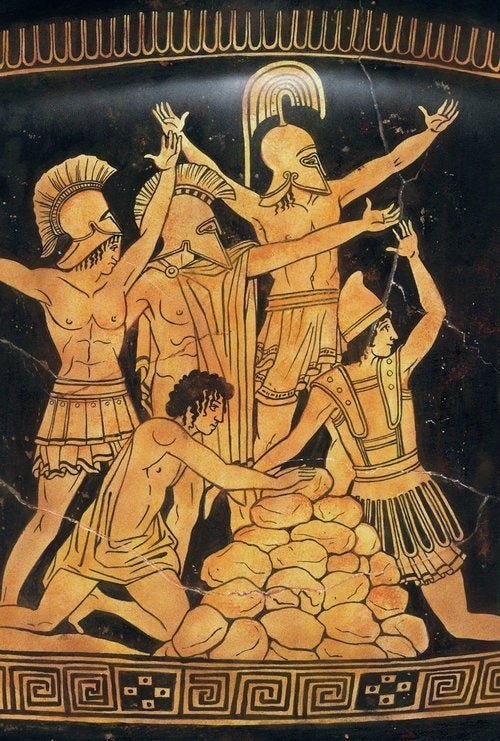
Before he could lead the Greek army to salvation, Xenophon had to seize control of it. This he accomplishes, like any true student of Socrates, with a series of speeches. He has to do this multiple times — first winning over his immediate band of soldiers, then moving upwards to wider and wider groups of senior officers. He shows impressive range in these addresses, going from reflective philosophical musing to detailed tactical analysis to rah-rah let’s get ‘em boys, as the situation and the audience demand. The speeches are very good — I’m reading them two and half millennia later and smiling along! — and sure enough the gods confirm their approval with various omens.10 But this is also the part where the Greeks suddenly seem a whole lot more familiar, and where I suddenly feel immense kinship. Leaderless and beset by enemies, they revert neither to anarchy nor to rule by the strongest, but to a deliberative citizen’s assembly. These hardened killing-machines know that when the state of emergency has been established and all conventional forms of legitimacy have broken down, it’s time to calmly open Robert’s Rules of Order and handing out ballot papers.
If the great paradox of the Greeks is that they were simultaneously a barbarian honor culture and also nuanced philosophical thinkers, then in some sense Anabasis reflects that entire paradox in miniature. It is an adventure story of a classic sort, and yet it also manages to serve as a case study of every major debate in Greek political theory. Xenophon is a masterful politician and quickly establishes himself as leader of the army. And because he understands the situation and is no fool, the very next thing he does is use democracy to abolish democracy:
“It remains for me to make what I think is actually the most important point of all. You are aware that our enemies did not dare to start making war on us until they had seized hold of the generals, thinking that while we had officers and were obedient to them, we were sufficiently strong to prevail in the war, but that when they had captured our officers, we would perish in anarchy and indiscipline. It is therefore necessary for the officers now to become much more careful than their predecessors, and for the rank and file now to be much more orderly and obedient to their officers than they were before. But in case someone is disobedient in the future, you must vote here and now that whoever among you happens to be there at the time is to join the officer in punishing him; thus the enemy will find themselves very much mistaken. For then they will this very day see the one Klearchos replaced by ten thousand who will not put up with any misbehavior.”
Xenophon understands that he needs to run the army as an absolute despotism in order to get them out of Persia alive, so he asks them here and elsewhere to vote to bind their future selves not to have the right to vote. Of course Xenophon is no dummy: he understands that he is just one guy, that the bonds of political order are fraying, and that a mutiny would end very badly for him. So any time he wants the army to do something especially controversial or risky, he forces a (carefully planned and manipulated) vote on it anyway, even though they’ve given up their right to vote. This doesn’t just renew his legitimacy any time it might be tested, it also makes the army complicit in his decision, so if it goes especially poorly they can’t put all the blame on him.
This is far from the only political challenge Xenophon faces. His army is a heterogeneous one comprised of soldiers from every part of Greece and every social class, plus a fairly large contingent of slaves.11 Very few of the soldiers are fellow Athenians, and his association with the Thirty Tyrants means that most Athenians would probably hate him anyway, meaning he has even fewer natural allies. The normal thing would be for a Spartan to command the army, both because Klearchos was a Spartan and because the Spartans are currently the overlords of Greece, so Xenophon finds a senior Spartan officer and acts like they’re theoretical peers while continuing to make most of the decisions.
He also understands the importance of good PR. While one source of his legitimacy might be the voting and the divine omens, another very important one is his personal conduct and demonstrated virtue. Xenophon performatively engages in the grungiest and most menial tasks required for the army (Klearchos did the same thing when he was in charge), and is intensely careful not to appear to be putting on airs. At one point he’s urging a group of his soldiers to hurry up a hill that the enemy is coming up the other side of, and one of them sarcastically observes that Xenophon is on a horse, so he immediately leaps off the horse, grabs the soldier’s shield, and starts outrunning him to the top.
There’s a very difficult needle to thread here, not just for Xenophon but for any leader: being a man of the people can increase your popularity, but human beings are hierarchical animals and maintaining a bit of ceremonial separation between subject and sovereign, between ruler and ruled, actually helps stabilize a regime as well. But not at the cost of losing sources of information. Xenophon is well aware of the failure mode that afflicts most modes of human social organization, wherein decisionmakers get an increasingly filtered view of the situation as their position gets more exalted. So he establishes a clear norm that any member of the army can skip all intervening layers of officers and come to him directly for any reason at any time, including waking him up while he’s sleeping. On multiple occasions this approachability saves the entire army from destruction.
The last tool that Xenophon uses to keep the army unified behind him while under unimaginable pressures is divine sanction. We’ve already covered the prophetic dreams, the sneezes,12 etc. But Xenophon also ensures the army keeps up a steady stream of animal sacrifices to keep the gods placated. He routinely consults auguries and multiple competing seers when consequential decisions must be made. Of course, Joseph Henrich would tell us in The Secret of our Success (reviewed by Jane here) that this is to implement an old-fashioned form of randomization. But Xenophon lets something slip that tips us off to the fact that more is going on. I know that ever since you read our review of Melzer’s book you’ve been itching to do some esoteric analysis, so now let’s practice it. At one point the army is trying to decide whether to attack one of the many random tribes along their route, and Xenophon sneaks in a sentence:
Yet though they performed many sacrifices, in the end the seers unanimously delivered their opinion that the gods would simply not countenance the campaign.
Did you catch that? Yet though they performed many sacrifices — Xenophon is playing the same game with the gods that the European Union does to its residents: when you don’t like their answer, make them vote again, and again, and again until you get the answer you want. Suddenly, all the times when the sheep’s liver looks exactly as Xenophon would prefer take on a different valence. Of course…he also might not mean that, which is exactly the point of this sort of “defensive esotericism,” it’s plausible deniability against any accusation of impiety, and as a student of Socrates he knows just how serious those can get.
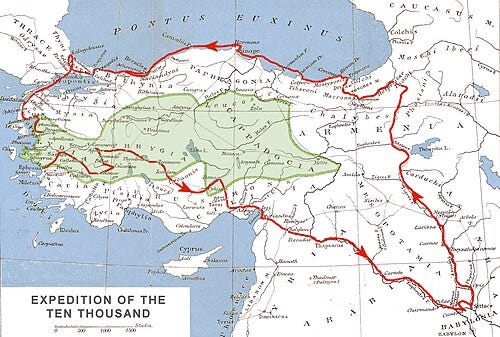
With the army firmly under his grasp, Xenophon now faces the problem of actually leading them thousands of miles across difficult terrain filled with hostile forces. The basic problem is that there are several very large rivers, notably including the Tigris and the Euphrates, that block the direct path back to Greece, and there’s no way the army can make it across them without being trapped and destroyed by the vastly more numerous Persian forces. Soon they discover that the Persians are also engaging in scorched earth tactics and burning down every nearby village to deny them forage.13 But Xenophon has read his Ben Horowitz: there is always a move. And the move in this case is to march around all the rivers, going far enough upstream that they become narrow and easy to ford. But that means venturing into territory beyond all known lands, a wild and mountainous region filled with monsters, and dragons, and worst of all…Armenians.
Yeah, it’s hill country, baby, and hill country is full of hill people, and hill people (as readers of this Substack know) do not mess around. Xenophon and his commanders clearly know, on some level, that things are about to get real. Right before they venture into hill people territory, they cleverly set an ambush for their own army by making them pass through a narrow ravine where officers can grab any slow-moving slaves the troops may have concealed “like a boy he especially fancied or a good-looking woman,” and then dispose of them by some means that are not elaborated upon (but all of the possible options are very dark). This is a defining moment for the army — if they were ever going to rebel, this is the moment. Xenophon is leading them into a truly dangerous place from which there is probably no going back, and at the same moment he is forcing them to sacrifice companions of whom they may have grown very fond. But they have no choice: the Persians are hot on their heels, and so they grit their teeth and march into the unknown.
It is every bit as bad as they fear. Remember, the Caucasus are not just any hill country, it’s a hill country populated by hill people for whom kidnapping the inhabitants of the next little mountain valley over was the primary component of GDP for much of history. As soon as the Greeks roll into their territory the attacks begin — sporadic at first, then ferocious and continuous. They hit and run, use the terrain to their advantage, outrange the Greek slingers and slowly bleed their heavy infantry. Xenophon and his generals have to invent novel tactics to compensate, but even so the going is savage. Some of the tribes described are very strange. There’s one that lives entirely underground. There’s one that has sex in public. There’s one that communicates over long distances by whistling (maybe). If you’ve read your Herodotus you’re probably rolling your eyes, but Xenophon is no Herodotus; everything he’s said up to this point checks out against the historical record, and there’s no reason to think he suddenly started making things up.14 Most intriguing to the modern reader: right when the army crosses over into southern Armenia, they encounter a people called the kardouchoi. Maybe I’m seeing things that aren’t there, but…could these be the ancestors of the Kurds? If so, I think it would be the first time they appear in recorded history.
The army eventually made it over the mountains and to the shores of the Black Sea and uttered the famous cry that has since been referenced in countless works of literature. That might seem like it should be the end of the story, since by reaching the sea they had reached greater Greece,15 a territory frequented by Greek trading missions and dotted with colonies like Trebizond and Sinope. But no, there were too many in the army to transport all of them by boat, and the march overland still had to cover lots and lots of hostile territory between the colonies, so their journey was barely half over. And in fact, the Greek presence in the area makes Xenophon’s job more complicated in a lot of ways. When the army was in total isolation it had to stick together by necessity, now holding it together becomes much harder. And the Greek colonies themselves don’t make it any easier — each of them sees the army as a powerful new player on the chessboard, and seeks to suborn or manipulate it into advancing their interests.
The resulting hijinks are fun throughout. One Greek colony tries to turn the army against Xenophon by spreading the scurrilous rumor that he plans to use them to found a city. The trouble is that this rumor is true, and he had actually been thinking about founding a city,16 which is part of why they’re so upset. With his plan leaked, Xenophon has to back off in a hurry and resume the trek back to Greece. On another occasion, agents of one of the other cities provoke the army into such egregious indiscipline that Xenophon decides he has to ritually purify them by forcing them to process between the split halves of a sacrificed dog. On yet another occasion, the army is manipulated into invading a neighboring barbarian kingdom that has a weird taboo where the ruler is never allowed to leave his tower and set foot on the ground17 (the Greeks simply burn it down). There’s a lot of this kind of thing. The journey is a slog. The grumbling gets worse. The ocean is right there and something has to give.
Something gives. A large group of Arcadians and Achaeans, grumpy at the failure of their scheme to extort the Heracleans, decides that it’s offensive for them to be under the command of an Athenian and splits away from the rest of the army with a half-baked scheme to go home by a more direct route. Within a hilariously short time they’re trapped and surrounded by a vastly more numerous barbarian army and facing certain destruction. Xenophon hears of this and immediately calls on his remaining loyal troops to go and rescue the splitters. He does this by appealing to their self interest, and arguing that without the whole army together they won’t be able to overcome the challenges ahead and make it home. If you’re a cynic, it’s easy to imagine that this argument from selfishness is what was going through Xenophon’s head too.
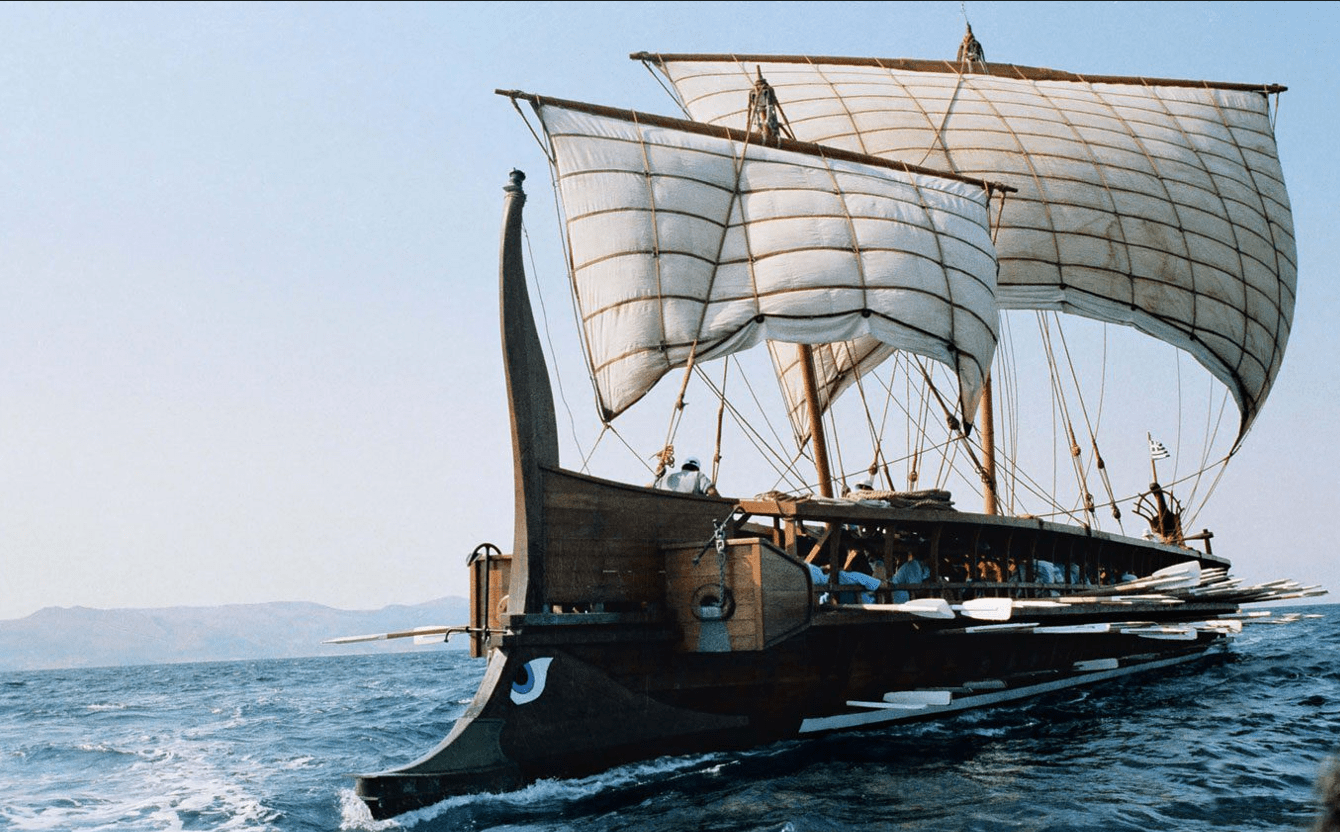
But I don’t think so. I think that Xenophon was an operator, and understood deep down inside that once you become one, once you take responsibility for the safety and success of a large band of followers, then you have a sacred duty to them come what may. My evidence for this is that a short while later Xenophon has an opportunity to abandon the army and take a boat home. Yes, there was no way to transport the ten thousand (now more like eight thousand) home on triremes, but at one of the moments of greatest peril and stress Xenophon gets a chance to wash his hands of this band of unruly, marauding losers and go home by himself. He doesn’t take it. How could he take it? Half of them may be a bunch of ungrateful mutineers, but they are still his charges. Taking up the crown does not mean you get to set it back down as soon as a more convenient opportunity presents itself.
I’ve argued before that the closest modern American equivalent to the Indo-European warrior band is the Silicon Valley startup, and indeed it used to be governed by an extremely similar ethos. It didn’t matter whether you ended up running a company by founding it, or by hostile takeover, or by battlefield promotion — once you were in charge, you knew that you were in it until victory or death, and that if things went poorly you were expected to go down with the ship. In some sense, practically all that a founder or a CEO does all day is make promises to people — promises to investors, promises to employees: “I promise you this will be huge. I promise you this will be good for your career. I promise that I will see this through.” I promise, I promise, I promise. Everybody always knew that in the end it might not be within your power to deliver on all of those promises, but you were expected to fight and struggle and try your very hardest so long as there was a hope of a glimmer of a chance of victory.
That culture is increasingly dead. There are many theories as to why this is: some blame the immense stakes and frenetic pace of dealmaking brought on by the AI boom, others think it has to do with the broad-based loss of cohesion and trust among US business elites. Whatever the case, the social contract between operators and investors on the one hand, and between founders and employees on the other, is crumbling. You see things now, like the bizarre non-acquisition of Windsurf by Google, that break every one of the unwritten rules of Silicon Valley. Startup world isn’t new to people acting in very selfish and short term ways (though everybody will tell you it’s gotten much worse), but the really disturbing new trend is the one where founders and a few key employees jump ship for unfathomable wealth while the remainder are left behind. It’s a violation of one of the most ancient codes: you got them into this mess, now you stay with them until you get them out.
Xenophon has several more opportunities to ditch the army and turns all of them down, instead opting to spend a brutal winter leading his troops around Thrace in service to a barbarian king because nobody else will pay them or give them food or give them a way home. A short while later, the book ends suddenly and ignobly. It turns out that keeping the army alive one more season was all that was required. The real Spartan army is launching an operation against a Persian satrap in Asia Minor, and Xenophon’s troops get summoned to participate, initially as their own unit and then gradually getting absorbed into the main body of soldiers. In other words, it ends with an acqui-hire, as so many startups do. The dreams of great wealth and fame are over, and their independence is over too. It’s back to being a wagie at AWS. And what about their leader, Xenophon, the operator who had no intention of being an operator until Zeus anointed him amidst chaos and betrayal? He doesn’t get to found a city, he remains exiled from Athens, and he retires to relative obscurity. But he does get to retire. Because while he did not bring them to great riches, he brought his people home to safety, and so now he can go home too. A free man once again.
This neologism is actually incredible It’s like something out of early 20th century Marxist propaganda, but they did it to themselves! This is not helping us beat the accusation that we live in a cleverly-disguised planned economy.
The gravitational attraction of merely talking about doing things is hard to escape. Andreessen Horowitz was founded as a venture capital firm made by operators and for operators, but these days alas it has mostly regressed to the mean.
Somehow they left this part out of the epilogue of the movie 300.
Seemingly every Persian emperor is named Cyrus, Darius, Xerxes, or Artaxerxes; but before we get too huffy it’s not like European monarchies got terribly creative with naming either.
One of my quack theories is that Greek homosexual pederasty was originally a steppe custom. Some other notable peoples who had institutionalized pederasty include: the Afghans (they call it bacha-bazi), the Timurids (the citizens of Sebasteia once tried to placate Tamerlane by offering him their prepubescent boys, he in turn showed that he meant business by having them trampled to death by his heavy cavalry), and according to F.W. Motte the Manchurians. All of these are peoples who recently emerged from the Eurasian Steppe.
Two pieces of evidence against this theory: (1) the Slavs, who also came out of Eurasia, and who even while pagan were famous for their extreme homophobia, and (2) the sheer number of other random societies practicing pederasty. Maybe the base rate is just very high.
Here’s one of several examples (note Xenophon always describes himself in the third person):
In Xenophon’s detachment was one Episthenes of Olynthos, who had a passion for boys. He saw a handsome boy, just in the first flush of adolescence and carrying a pelte, who was on the point of being killed, and he ran up and entreated Xenophon to go to the boy’s aid. Xenophon went to Seuthes and asked him not to kill the boy, explaining Episthenes’ proclivities and that he had in the past recruited an entire company using as the sole criterion whether those in question were handsome; Xenophon added that with these troops he proved himself a good man. […] Therepon Episthenes put his arms around the boy and said, “The hour has come, Seuthes, for you to fight it out with me to the end over this boy — for I will not give him up.” Seuthes laughed and let the matter go.
The pardoned rebels did a good bit better than some people in the king’s own army. Queen Parysatis was pissed off at the death of her favorite son. She had the soldier who killed him put on the rack for ten days, and then had his eyes gouged out, and then had molten brass poured into his ears until he died. The guy who cut the head off his corpse on the battlefield was flayed alive. The nobleman who initially tipped Artaxerxes off about the coup attempt she convinced him to have assassinated while in the bathtub and his severed head displayed to the court.
Throughout the book Xenophon always speaks about himself in the third person.
The most important omen mentioned is that at several key points during Xenophon’s speech, a soldier sneezes. Yes, you read that right. I was also confused by this. It turns out that not just the Greeks, but many ancient peoples, considered the act of sneezing to be a minor theophany or intrusion of the gods into the affairs of men. Think about it for a moment and it makes sense: sneezes are unpredictable and irresistible, they come over you and take control of you and force you to act in a certain, viscerally physical way. Like an incredibly minor instance of spirit possession. When soldiers sneeze after Xenophon finishes a thought, it’s because the gods have decided they agree.
In one touching episode, a slave suddenly realizes that the hostile tribe whose territory they’re passing through is the one from which he was captured as a child, and is able to negotiate their safe passage.
Read footnote number ten!
Xenophon tries to spin this in a positive way to his troops:
“Men of Greece, do you see that they are already conceding that the land belongs to you? When the truce was made, they stipulated that there should be no setting fire to the King’s lands, but now they themselves are setting his land on fire as if it belonged to someone else.”
Never underestimate just how weird human societies can get.
No not that Greater Greece.
Imagine! A time when somebody with a giant band of followers could just decide to pick a promising spot and found a city. This is so far outside our lived experience today, I don’t even know how to relate to it. I guess the closest thing today is founding a company, but that is quite lame by comparison.
The translator includes a footnote here saying that this was actually not an uncommon taboo in Bronze Age Mediterranean societies. Naturally, I immediately thought of the analogous way that Chinese emperors were sequestered.
1. Concerning "Capital Allocators" and Finance Bros - we have something like a planned economy, or at least like socialism, for the rich. Austerity for the peons.
2. I would like to say that it was no secret that the Ancient Greeks were a society of war crazed, boi crazed assholes, but I'd be wrong. Years ago, I read an asinine article in "The American Conservative" to the effect that "America Must Reclaim Its Spartan Heritage".
My response was - "what part of 'Spartan heritage', are we talking about? Are you referring to the exposure of infants, the caste system enforced by periodic massacres of helots at spearpoint, the mania for pederasty, or just the slavery?"
"The American Conservative" published some good and a lot of stupid articles, but one thing I did appreciate about them was that their comment section allowed criticism, even criticism far more scathing than mine.
3. "I’m sure some of this is an unfair comparison because the Persians we meet are closer to the median Persian whereas the Greeks are an all-male band of elite mercenaries, and Bronze Age gonna Bronze Age."
Pretty sure the Anabasis took place in Iron Age Greece.
"median Persian"
I laughed at this unintentional pun.